Showing posts with label The Yeast Bay. Show all posts

Sunday, 28 June 2015

Tasting Notes: Saisons w/ Yeast Bay Saison Blend

As you might have already noticed, posts to this blog are going to be a bit more infrequent over the summer.  I'll try to schedule a few tasting notes posts for while I'm away in England, and I'll post any interesting beer related activities over on the blog's Facebook page.  Since I'm going to be posting less frequently, I've decided to try to combine various beers together into longer posts.  Here we have a couple of beers brewed with The Yeast Bay's saison blend.

This is the second time I've used this blend in an almost identical series of beers, and I have to say that overall, I'm a big fan.  It reliably delivers a 'classic', yeast driven saison profile that I think works very well for clean saisons.  It ferments relatively quickly, and seems to get beers reasonably dry as well.  Both these finished at around 1.004.  I can usually get them lower with Wyeast 3726, and in future if I brew these again I would change the the bitterness slightly to balance the higher F.G.  One thing I have noticed is that, at least when I've used it, the blend seems to put out a lot of sulphur in the second generation.  This doesn't seem to be unusual in saison yeasts (Wyeast 3724 did the same), and it usually dissipates before bottling, but it can be a bit unnerving if you're an air-lock sniffer like me.

After the tasting notes I've posted some thoughts about the carbonation and head-retention in these beers.  As I noted in my last post, I've made a number of changes to my saison brewing process over the last few months, so I'll try to include reflections on these in my tasting notes.  Here, because I was trying out a new camera, I took a range of photos over a short period of time, so I was able to record how the head dissipated on the beer.

Spelt Saison with Saphir Hops

This beer was based on previous recipes I've made using large quantities of low AA hops---in this case, 4oz of Saphir rated at 1.8%, supplemented with some Hallertau for bittering, all in a three gallon batch.  I generally prefer to get bitterness from large doses of low AA hops, in part inspired by Yvan de Baets descriptions of the hopping rates in old saisons, but also because I find it gives a pronounced bitterness that is rarely astringent or biting.  I suppose I should worry about getting grassy tastes from having so much vegetal matter in the boil, but I have never noticed this, at least not to any degree that I find unpleasant.  I think the spelt also helps to soften the bitterness by rounding out the mouthfeel slightly, which prevents the beer from tasting too sharp.  This recipe included 30% unmalted spelt in the grist.

The O.G. was 1.040, and the F.G. around 1.004, giving an ABV of 4.6%.  Given how rounded and soft the beer tastes, I think I could happily drop the O.G. down into the 1.030s, aiming to produce a beer around 4%.


Appearance:  Pale golden colour.  Billowing head on pouring that recedes to about half an inch after a few minutes.  (More on that below.)

Smell:   Distinctive yeasty 'saison' smell that I'm having trouble describing fully: it reminds me a bit of North Coast's Puck.  A bit of grapefruit and general citrus, very light peppery spice, and maybe a hint of plastic.  Lovely smell: the hops accentuate the yeast blend nicely.

Taste:   Slightly sweet up front, then grapefruit zest and white pepper.  Really nice, but then it finishes a touch too sweet for me.  The spelt adds a slight savoury note, which I want to try to make more pronounced in future, in line with what you see in Brasserie Blaugies beers like Saison D'Epeautre and La Vermontoise.

Mouthfeel:  Prickly carbonation with a round soft mouthfeel thanks to the spelt.   What lingers is a slight sweetness rather than the gradually building bitterness I'm looking for.

Drinkability & Notes:  As I mentioned above, both these beers finished a few points higher than I would have liked (though still drier than many other beers), and unfortunately this translates into a slightly sweet and cloying character.  Ideally I'd get round this by having the beer attenuate a few more points, but I think a more pronounced bitterness, accentuated with some gypsum, might have the same effect.  The blend definitely delivers in terms of classic saison character, and works nicely with the Saphir hops.

Classic Saison with Crystal and Sterling Hops

This beer is a version of the Classic Saison recipe from Farmhouse Ales, but with American hops subbed for the European varieties suggested in the recipe.  The grist was 90% pilsner and 10% wheat, and the O.G. was 1.050, higher than I usually go for my saisons.  With an F.G. of 1.004, this gave me 6% ABV.
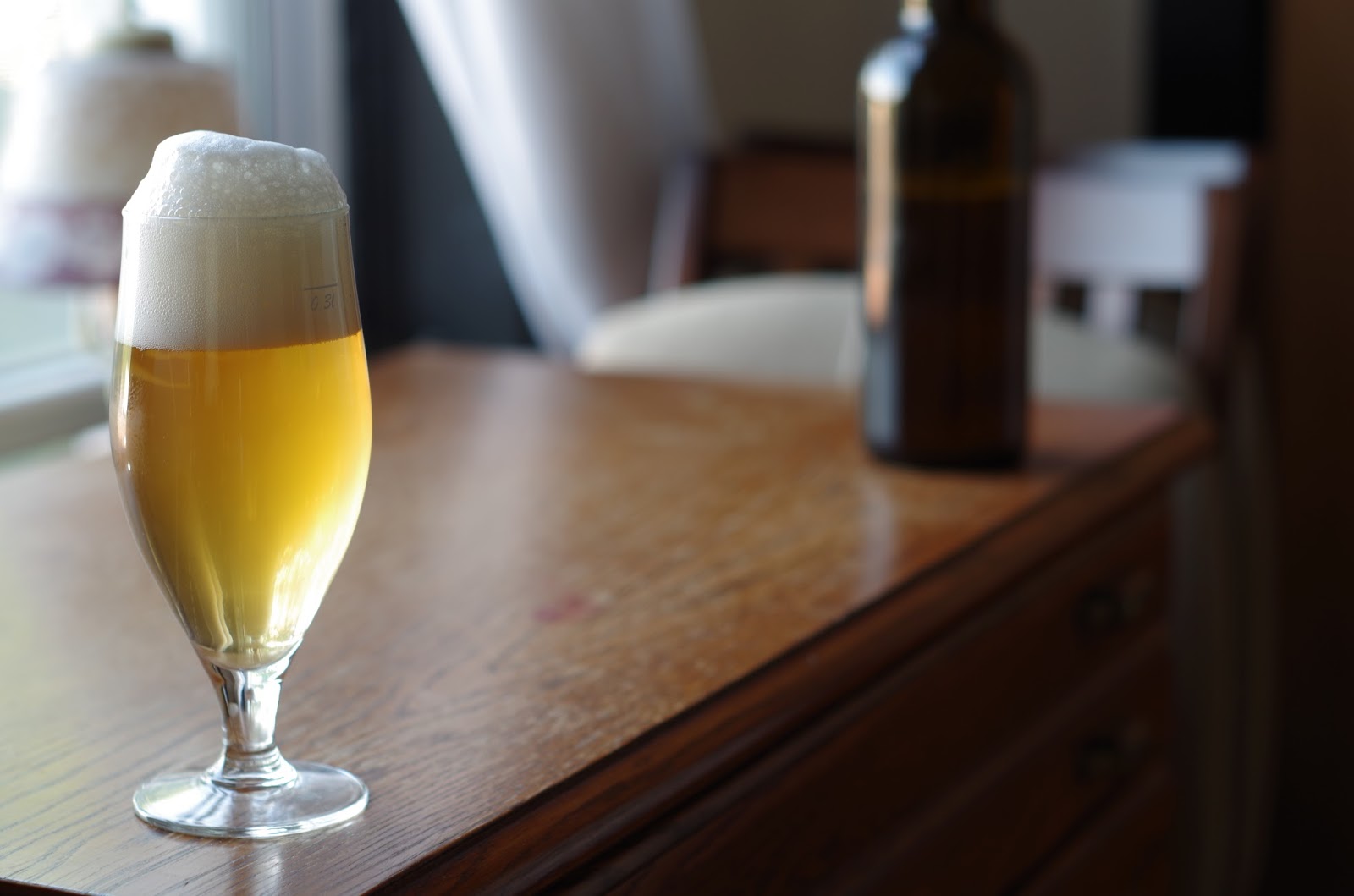


Appearance: Standard golden colour, with a rocky head that dissipates to about a half inch.  Moderate lacing.  (Again, more on this below.)

Smell:  Same 'classic' saison character, but more subdued here.  Grapefruit is there but not as prominent, and I also get a bit of blackcurrant too, with less peppery spice.  Its all supported by a sort of musty, earthy funk---I don't know if this is from the hops, or if the beer picked up some brett from my saison equipment.

Taste:  Zesty, peppery saison character, but not as pronounced as it was in the other beer.  Transitions to that slightly musty funk along with a light bitterness at the end.

Mouthfeel:  Not as rounded as the spelt saison, despite that fact that it had a higher O.G.  Crisp and quite dry, with enough bitterness to balance the beer but not enough that it asserts itself.

Drinkability & Notes:  A fairly enjoyable spin on something like Saison Dupont, though not a clone by any means.  The slightly musty character detracts from the overall impression for me, perhaps because its not what I was going for. though its probably more subtle than these notes suggest.  The beer is crisper and more refreshing than the spelt saison, but I'm more excited about brewing modifications of the latter.

Step Mashing, Adjuncts, and Carbonation

These beers reflect a couple of the changes I've made to my process over the past few months.  First, both were made with a step mash that included a protein rest in the low 130s.  I didn't use an under-modified pilsner malt, but obviously the first beer contained a significant amount of unmalted spelt (30% of grist).  I think in this case I added the cereal -mashed spelt after the protein rest to get the beer up to the first saccharification rest, which might be the wrong way to do this (i.e. perhaps the spelt should be in the mash during the protein rest).

I also carbonated both beers to approximately 3 volumes (this works out at a convenient 100g of sugar per batch for me).  Its also worth nothing that both beers, but especially the spelt saison, had a lot of hop matter added in the boil.

Together these changes have yielded a definite improvement in the appearance of these beers.  Both had billowing heads on pouring, and there was some retention at around five minutes after pouring, as you can see from this sequence of photos.


The beautiful rocky head in the picture of the Classic Saison came from topping up the beer after the initial pour.  I'm not sure why exactly, but I think I've noticed this happening before: the first pour billows and dissipates somewhat, whereas the second sticks around and rises above the top of the glass.  My memory is that the Classic Saison had slightly better head retention, settling at over half an inch, and the pictures below seem to confirm that (though I wasn't particularly careful about the times,  and the different glass might also have supported better head retention).


As I said above, overall I'm much more excited about the Spelt Saison, even though the Classic one came out a little better this time round.  Its partly because I just prefer beers with lower alcohol, but also because I know that with a bit more bitterness to balance the slight sweetness from the rounded mouthfeel and higher than normal O.G., it will make for a really pleasant everyday beer.

Wednesday, 25 March 2015

Tasting Notes: Lochristi Peach Sour (Yeast Bay)

I think one of the most important lessons I've learned over the last few years of brewing sour beers is patience.  I'm not talking about patience while the beer is in the fermenter, but rather about patience after the beer is packaged in bottles.  In the past I'd happily wait months and months for a sour to age in secondary, only to expect it to be ready two or three weeks after bottling like any other beer.  I quickly learnt that some sours taste bad after a few weeks in the bottle:  I've experienced diacetyl, tetrahydropyridine, low carbonation, and weird brett phenols that fade after a month or two.  But what I didn't fully appreciate was that even though a beer can taste OK after a few weeks in the bottle---no off-flavours, etc.---it can still take many months to come into its own.

This beer is a case in point.  It tasted fine after a few weeks, even months, in the bottle.  The peaches were subtle but present, there was a nice lactic sourness, and even some fruity esters from the brett, but it all seemed a bit one-dimensional and boring.  Almost like a less sour version of a fruited berliner-weisse: tart, fruity, and refreshing, but not particularly memorable.  But in the last month or so this beer has really come into its own.  The change wasn't particularly radical: its not that I can point to distinctive new flavours or aromas.  Instead, it's just melded together and softened so that where before it was angular and assertive, now its elegant and subtle.  Of course, now I only have one or two bottles left!

You can find details of the original beer in the post linked to above.  It was inoculated with The Yeast Bay's Lochristi blend, and aged on some peaches from a local farmer's market.  The peaches were never particularly assertive in the beer, and now they blend seamlessly with the other flavours.  (I'm not sure anyone would say that this is a Peach Beer, but they might pick peach as a flavour descriptor.)  The profile from the Lochristi blend is very similar to other beers I brewed with it, but it works particularly well here, rounding the beer out with a soft fruitiness that complements the peaches nicely.

Appearance: Rich yellow colour.  Head dissipates quickly.

Smell: Peach skins and overripe fruit.  Melon.  Green strawberries?  Yogurt-like tang underneath it.

Taste: Peaches and sweet melon.  Soft acidity.  Slightly doughy malt.  Very enjoyable.

Mouthfeel: Soft and well-balanced.  When this beer was younger and more one-dimensional I wanted more carbonation, but now I like the lowish-level because it adds to the soft fruitiness.

Drinkability & Notes:  I love where this beer has ended up.  Its one of my favourite sours in fact, although I suppose its barely more than tart.  I think it works so well because the beer is quite delicate and subtle: a more assertive brettanomyces blend, or more prominent fruit, would turn this into a completely different beer.


Tuesday, 18 November 2014

Tasting Notes: Farmer in the Rye w/ Wallonian Farmhouse

The second beer I brewed with The Yeast Bay's Wallonian Farmhouse strain was based on Ed Coffey's Farmer in the Rye, inspired by this write up of his own experiences with that yeast.  The beer has subsequently come first in its category in two local competitions: Brixies Brewers' Brixtoberfest and Chicago Beer Society's Spooky Brew.  All credit to Ed and his excellent recipe! It scored 36 overall at Brixtoberfest, but frustratingly the organizers misplaced my scoresheets so I didn't get any feedback; that was why I entered it in Spooky Brew as well, where it scored 40 (and was, I think, judged by Jeff Sparrow of Wild Brews).  Since people seem pretty interested in these new strains, I've reproduced the judge's tasting notes below (as best I could---the handwriting was difficult to decipher in places).

First Judge

Aroma: Dominant fruity pineapple and lemon citrusy aromas.  Moderate spicy, peppery aromas in background.  Touch of sugary sweetness in finish.

Appearance: Pale golden in color with a slight haze and lasting, cream white foam.

Flavor: Starts with pleasant peppery phenols balanced by a touch of sweetness and enhanced by a touch of acidity.  Fruity, citrus character comes across in background with a fruity, peppery finish.

Mouthfeel: Medium-light body and high carbonation good for style. Exhibits a moderate astringency and notable[?] [?????]  warmth. [probably "alcohol", though it doesn't look like that!]

Overall Impression: Fruit and pepper with a bit of sweetness and acidity in background for support.  Just a bit of astringent, perhaps oxidized character in the finish.

Second Judge:

Aroma: Strong, high citrus esters, with a lemon character; medium to low pepper spice aroma; low bready malt aroma; low solventy, alcohol aroma; low earthy hop aroma.

Appearance: Beautiful light straw color with medium haze; large head, white with long retention and a delicate texture.

Flavor: Medium-high tartness and lemon-like ester predominate; medium pepper spice flavor follows; medium to low bitterness and cracker-like malt flavor; perhaps a low cardboard flavor is perceived in the aftertaste.

Mouthfeel: Light body, high carbonation with a lively effervescence; medium alcohol warmth with a puckering sensation on the tongue.

Overall Impression: A refreshing, easy to drink example of the style -- well done!  The tartness and lemon esters predominate and are pleasant.  There may be a slight oxidation problem which I am perceiving as staleness in the aftertaste; might be interesting to manage the yeast to increase the spicy component.


So, there you go!  Much better than the tasting notes I would have written for this beer---some of the most detailed and helpful I've got from the few competitions I've entered, actually, so I'm grateful to the judges.

I'd be remiss if I didn't mention that, for a long while, this was my least favourite of the three beers I brewed with this strain. I felt that it needed a little more tartness or bitterness to cut against the sweetness---not at all something you'd gather from the judge's tasting notes, which probably just goes to show how idiosyncratic my palate is here!  I've actually noticed with all the WF beers that the tartness has increased steadily over time, and as that happens I find myself reaching for bottles of this beer more and more frequently.

One final note: I think the carboard aftertaste was there in the first beer I brewed with this strain.  That doesn't mean its not a process-related issue: in fact, I noticed a few months ago that the spigots on one of my bottling buckets lets in a small amount of oxygen if not opened properly, which might explain this, though its possible that there is some other yeast-derived flavour that the judges are picking up on.

Saturday, 25 October 2014

Coupage: Hoppy Saison with Wallonian Farmhouse strain

Here's some tasting notes for the third beer I brewed with the Yeast Bay's Wallonian Farmhouse strain (I'll write up some summaries of the beers I brewed with this strain, and the saison blend, in the next week or two).  The base beer was a pale saison dry-hopped with Hallertau Blanc and Eldorado hops that I won in a recent HBT giveaway by Hop House Brewing Supply.  At bottling I blended this beer with ~2 liters of the no-boil sour I brewed earlier this summer.  At first the hop character was a bit too much, but as its faded this has turned into quite a nice saison.

Appearance: Pale yellow colour.  Thin but lingering head with some lacing.

Smell: When it was freshly bottled, the aroma from the dry-hop of Hallertau Blanc and El Dorado was pretty strong, almost dank.  Now that's faded a bit its left a really intriguing combination of light fruitiness (yellow stone fruit, berries, lemon) and spice from a combination of the hops and yeast.  Light brett c funk is beginning to show itself as well.  Not as complex as an aged saison, but enjoyable.

Taste: Lightly tart. Fruity, slightly spicy hops are prominent, along with a very subtle musty funk.    Slightly astringent bitterness---I'd back down a bit next time, or use a variety that gives a softer bitterness.

Mouthfeel: Moderate carbonation, and slightly slick mouthfeel---this strain seems to produce a lot of glycerol, a bit like Wyeast 3711.  The tartness balances it nicely though, making it more drinkable than other beers I've brewed with this strain.

Drinkability & Notes:  I like this beer a lot.  Certainly my favourite of the three I've brewed with the Wallonian Farmhouse strain.  The tartness from the sour cuts nicely against the fruitiness from the yeast and hops, producing a beer that is complex but drinkable.  I could drink several of these back to back, which isn't true of the other beers I've made with this strain.

Friday, 10 October 2014

Tasting Notes: Bitter Spelt Saison

Here's some tasting notes the third and final beer I brewed with The Yeast Bay's saison blend.  It's another attempt to brew a bitter saison in the mold of Brasserie de la Senne's Taras Boulba and the beers Yvan de Baets describes in his essay on Farmhouse Ales.  I was prompted to brew this one when, on opening an order from Label Peelers, I found that they'd included a free pound of year old Celeia hops in 1 oz. bags!  Large doses of low alpha hops are exactly what Yvan calls for in his description of these beers, so I decided to throw most of what they gave me into a single three gallon batch.

Appearance: Hazy yellow colour.  Thin lingering head with good lacing down the glass.

Smell: Floral and a little spicy, with some hints of pear and lemon in the background.  Doughy malt as well.

Taste: Dominated by a herbal and spicy hop character that is very reminiscent of Taras Boulba.  Similar malt profile as well, but also a slight tartness and more prominent yeast character.

Mouthfeel: Soft and slightly creamy mouthfeel from the spelt/wheat helps balance the bitterness to some extent.  Still dry, and of course a firm and lingering bitterness.  Its perhaps a little much by the end of the glass---not astringent, but it builds and becomes a bit minerally if you're not eating something along with the beer.

Drinkability & Notes: When I opened the first bottle of this beer I thought I'd ruined it with the dry-hop of Styrian Goldings.  It had an over the top pear/floral character that was quite off-putting.  But now that's faded slightly, I'm quite happy with how this one turned out---its probably my most successful attempt to brew something along the lines of Taras Boulba, though its certainly not a clone of that beer.  The bitterness means I could never enter this in a competition as a saison, but its the kind of beer I want to brew for myself.  Still needs more work, but getting closer to what I have in mind.

Recipe:


Measured O.G: 1.039
Measured F.G: 1.004

Mash: 149°F main mash
Cereal mash for spelt.

Malt:

58.0% Pilsner
16.3% Flaked Wheat
14.8% Unmalted Spelt
10.9% 6-row 

Hops:

Celeia             60               15  IBUs     (28g@2.69%)
Celeia             30               7.7 IBUs     (28g@2.69%)
Celeia             15               4.0 IBUs     (28g@2.69%)
Celeia             5                 2.5 IBUs     (28g@2.69%)
Celeia             0                 0.0 IBUs     (28g@2.69%)
Styrian G.       Dry Hop                        (20g)

Yeast:

Yeast Bay Saison Blend

Tuesday, 16 September 2014

Update II: Yeast Bay Saison/Brett Blend

It's been almost seven months since I brewed these saisons with the saison/brett blend from The Yeast Bay, so I thought I'd post a second update on how their flavours have changed (my first update here, and links to original beers below).  Since my batch size is so small (and these all tasted pretty good young) I only have a few bottles left of each, so this may be the last update I post on them.  If you can't be bothered to read it all, the gist is as follows: the hops have faded, and the more fruity flavours from the brettanomyces are now accompanied by a fairly pronounced funk; it works well in some of the beers, but is too much (for me) in others.

Spelt Saison

This was one of my favourite home brews when it was young.  You can read my earlier tasting notes here.

Appearance: Hazy yellow colour.  Billowing head, but it dissipates almost entirely.

Smell: Still that slightly citrusy fruitiness, but with a musty funk behind it.  Like gym socks maybe?  Its a smell I get from some cheeses I think.

Taste: Citrus rind bitterness still, accompanied by general fruitiness.  Musty funk at the finish.

Mouthfeel: Dry but not thin.  Bitterness is still pronounced, but the beer has enough body (from the spelt?) to support it.  Mid to high carbonation works well.

Drinkability & Notes: I still really like this beer, though I can't imagine serving it to many other people.  The bitterness is very firm, and there's still some of the same citrus character it had when it was  young, along with a new level of musty funk.  I've brewed a few saisons that have this combination of lingering and persistent bitterness with low-level funk, and loved every one of them.

Traditional Saison

My original tasting notes are here.

Appearance: Beautiful, glowing gold.  Brighter than before, but still with a slight haze.  Frothy head that recedes to half an inch but lingers for a good while.

Smell: Fruity up front, but with a more pronounced and pungent funk beneath it now.  Gym socks again (!) and damp leaves, but at low enough levels that I can enjoy it.

Taste: Follows the smell, but with the fruitiness a little more pronounced and the funk right in the background.  The fruitiness combined with the slightly metallic bitterness really reminds me of some kind of berry---strawberries maybe.

Mouthfeel: Slightly higher carbonation than before really helps this beer shine.  Dry but not thin, pleasant and lingering bitterness mixed with the fruitiness of the beer.

Drinkability & Notes: This one is definitely drinking well at the moment, and I'm sorry I have so few bottles left.  I suppose it doesn't taste much like any commerical saison I've had---but to be honest, I'm starting to realize that I don't like a lot of them, especially interpretations I've tried by US breweries that are readily available around Chicago.  So, if you like saisons, take everything I say with a pinch of salt!

New World Saison

My original tasting notes were part of my last update on this blend.

Appearance: Again a beautiful, glowing gold colour, and a lingering frothy head.  These beers differ more than the photos show, but not by much.

Smell: I feel like the fruitier aspects of the Nelson Sauvin come out more now than they did before, and the garlicky/green onion smells have faded a bit.  But not entirely, and they're now joined by the sweaty foot locker smell of the brett.  Intriguing at first, but ultimately a bit too funky for me. (I remember thinking the same thing about the last bottle of Prairie 'Merica I had.)

Taste: There's that green onion taste!  Mingled with the musty funk of the brett, I'm just not a fan.  I want the fruitiness more prominent, and the funk as a complement in the background.  In fact, you know what it smells like?  The mix of garlic/onion and body odour that you get from aged Limburger.  I like the cheese when its just beginning to turn that way---and I think I'd feel the same about this beer.

Mouthfeel: Solid.  Decent carbonation and not too thin.  I'm just not enjoying the beer.

Drinkability & Notes:  I don't know if its just the fact that my hops were a little old (though properly stored), or that I just don't like this combination with the brett---either way, this beer is too much for me.  Maybe someone else would enjoy it---as I said, I think I might have felt the same way about Prairie 'Merica in the end.

Friday, 22 August 2014

Tasting Notes: Lochristi Grisette

Inspired by this excellent write up at Ale of the Riverwards, I thought I'd come back to one of the beers I hadn't written about from my first order from The Yeast Bay.  It is a grisette fermented with Wyeast 3522, with half a vial of the Lochristi blend added in secondary; I also added some oak cubes that were fresh from a beer fermented with lactobacillus and White Labs brett trois.

I called it a Grisette for no better reason than that it had a high percentage of wheat and oats (see recipe below).  This ended up giving the beer a slightly creamy body that I'm not too keen on, which is exacerbated by the low carbonation and light hopping. I deliberately aimed for this low carbonation, expecting the brettanomyces to eat through the last remaining gravity points---but there's been little change since bottling. Its developed a light but definite tartness during secondary, which might mean that some lactobacillus survived on the oak cubes---though this could also be from the brettanomyces, since the website blurb says it can "impart a pleasant acidity over time".

The blend itself doesn't really shine in this beer, but I think that's a problem with the recipe more than anything else.  The second beer I fermented with this blend was a golden sour.  I transferred this onto 3 lbs of peaches a few weeks ago, at which point it had a similar flavour profile to this beer, but with more sourness and funk to back it up.  Hopefully the peaches will elevate it further.

Appearance: Hazy golden colour.  Head dissipates to a thin cap leaving some lacing.

Smell: There's a distinctive aroma profile I've found in both beers brewed with this blend, but its hard to find words to describe it beyond generic descriptions like "fruity".  The blurb on the website mentions strawberries, and I think I can see that, but to me its more of a green unripe strawberry than a luscious fresh berry.  There's perhaps some yellow citrus fruit too, and as I swirl up the glass I get more musty and earthy funk beneath the fruit.

Taste: Lightly sour, slightly lemony, and maybe a touch of orange peel.  Its comes together nicely, but its hard to pick out individual flavours.

Mouthfeel: The carbonation is low, and the mouthfeel fairly creamy.  For me, this detracts from the beer: I think if it were more spritzy it would be very refreshing, and the flavours might pop out more.

Drinkability & Notes: Not a bad beer by any means, but not particularly memorable either.  The contribution from the Lochristi blend is pleasant but subtle, and not enough to carry the beer by itself.  The light lactic tartness helps, but really it needs higher carbonation and maybe a dry hop to liven it up a bit.


Recipe:


Measured O.G.1.041
Measured F.G.1.002
ABV.5.1%
Mash:149°F
Malt:
64% 2-Row
18.3% Wheat Malt
9.1% Vienna
5.4% Golden Naked Oats
3.2% Table Sugar
Hops:
Hallertau (US)60 min23.9 IBUs(25g@ 5.4%)
Styrian Goldings15 min5.8 IBUs(20g@ 3.29%)
Fuggles (US)2 min0.9 IBUs(15g@ 4.1%)


Yeast:
WY3522; Lochristi Blend 
         

Sunday, 27 July 2014

Tasting Notes: Wallonian Farmhouse Saison

I’ve been putting off writing tasting notes for this beer, as its a bit of a strange one.  The yeast performed pretty well, accentuating the malt and yielding some intriguing phenols and esters.  But the base recipe gives a saison with a different character to the pilsner/adjunct based beers I’m used to, and its taken a while to adjust to it.

IMG_1900Appearance:  Hazy orange colour, verging on a light russet brown.  Head dissipates to 1/4 inch, which lingers for a good while, but with no lacing.

Smell: Bread-crust, dried fruit, light spice, and gentle smoke.  The vienna and amber malt really pop out on this one, especially as it warms up.  Dried fruit and warming spice are there, but subtle.   J says it “smells like some kind of cake that old people like”.  I don’t know that I would have come up with the “smoke” descriptor myself, nor would I have expected this if you warned me that a beer smelled like smoke.  And yet, somehow, it really fits.

Taste: More bread-crust, slight spiciness along the tongue, and then the dried fruit and smoke.  Slightly tart.

Mouthfeel: Low to medium carbonation.  There’s a slight slickness to the mouth-feel, which lingers in a way I’m not particularly keen on.  Higher carbonation (or more bitterness) might help scrub this out.  I thought it was glycerol from the yeast, but I gave a bottle to Michael Thorpe of Spontaneous Funk, and he thought he picked up some diacetyl (which I’m pretty bad at detecting).

Drinkability & Notes: I don’t reach for one of these every time I go to the fridge, but its been growing on me a fair bit.  The beer has a slightly autumnal feel to it: distant bonfires, harvest bread, that sort of thing.  I’m certainly looking forward to subsequent beers I brewed with this yeast, and I might even return to this recipe in the Autumn. 

Wednesday, 16 July 2014

Tasting Notes: Classic Saison with Yeast Bay Saison Blend

I have a bunch of beers I need to write tasting notes for at the moment.  Here’s the first: its based on the classic saison recipe from Farmhouse Ales, and brewed with The Yeast Bay’s Saison Blend.

IMG_1877
Appearance: Beautiful hazy golden colour.  Head dissipates to thin lingering cap. No lacing.

Smell: Pleasantly fruity---that almost plastic-like fruitiness you can get from saison yeasts.  Apple skins, sweet melon, and unripe banana.   Slight pepperiness beneath it all.  Not as much citrus as the saison/brett blend.

Taste: Tangy and juicy!  Really mouth-watering actually, with more of that fruit from the nose, and a tingling spiciness across the tongue as it finishes.

Mouthfeel: Dry but not thin---perfect for a saison.  Moderate carbonation. 

Drinkability & Notes: I really like the tangy and tart flavour profile of this blend---it makes for a very quenching beer (which led me to use the second generation in some lower gravity saisons). I’ve been keeping an eye out for local competitions to enter this one in, as I think it would do well in the saison category.  It is very much along the lines of something like Saison Dupont.  I’ve been enjoying it a lot, even though I usually prefer something a little more bitter.

Update (15/08/14): I entered this beer in a small local competition.  I've pasted the comments from both judges below:

First Judge

Aroma: 7/12              Light pale malt. Lacking spicy phenols. Light sulfur aroma

Appearance: 3/3        All Good

Flavor: 12/20             Dry Pale Malt flavor. “Waxy” Yeast character (candy wax). Mild malt sweetness.         
Decent balance.Dry finish

Mouthfeel: 4/5            Spritzy Carbonation

Overall: 7/10               Nice Effort. Clean and well made

Stylistic Accuracy: 4/5

Technical Merit: 4/5

Intangibles: 4/5

Score: 33/50

Second Judge

Aroma: 8/12            Good. Spice lacking just a bit

Appearance: 3/3      Good.  Medium to high carbonation

Flavor: 13/20           Mild spice.  Hints of bubblegum.  Tart finish.

Mouthfeel: 4/5         Slightly high carbonation

Overall: 8/10            Nice job would like a bit more spice and peppercorn

Stylistic Accuracy: 4/5

Technical Merit: 4/5

Intangibles: 4/5

Score: 36/50

Sunday, 1 June 2014

Brew Day: Yeast Bay Saison Blend

Classic SaisonThis morning I brewed another saison with the second part of my last Yeast Bay order: the Saison blend. I wanted to go with a fairly straight-forward saison recipe to see what the blend contributed, so I used Phil Markowski’s “Saison – classic version” from Farmhouse Ales.  I almost always use some variation on the grist from this recipe when I brew a saison, but I lower the gravity and up the bitterness by quite a bit. In fact, I remember when I first read the book I was confused and disappointed by the fact that the recipes at the back didn’t seem to fit the descriptions of saisons provided by Yvan de Baets in the earlier chapter.  That said, it probably does fit with what people expect from a saison (i.e something like Dupont), and I suppose that’s not a bad thing, so today I basically went with what was printed.

I’m hoping to pitch the second and third generations of this blend into other batches: the recipes will depend on how this first one comes out.  I have never used a blend of saccharomyces before (only saccharomyces/brettanomyces), so it will be interesting to see how the blend changes over time.  I suppose it will depend on the growth rates of the two yeasts, as well as their flocculation (I’ll be harvesting from the primary fermenter in a week or two).

pH meterBut the yeast strain isn’t the reason I’m posting about this brew day.  Today was the first time I used my new pH meter to check on things in the mash and boil kettle.  I ended up getting the Milwaukee Instruments MW102, which seems to be the standard one at this price offered by most homebrew stores.  I was torn between ordering this from Amazon, or ordering the Hach Pocket Pro+.  The latter was recommended by ajdelange on HBT, and seems to be getting positive reviews from other home brewers.  But the wait time for ordering was significantly longer, and with shipping and tax the whole was 20-30% more expensive, so I decided to stick with the Milwaukee model (or rather J did, since it was a birthday present).  Hopefully I won’t regret that choice! It occurred to me today that its the single most expensive piece of brewing kit I have: obviously I’ve spent a lot more than $100 over  time on fermenters, grain, hops, etc., but everything else I’ve got on the cheap.
I’ve been using Bru’n Water to estimate mash pH for a few months now.  Chicago water has pretty high residual alkalinity, meaning that its good for brewing dark beers but needs some adjustments if you want to hit the right pH for anything light.  I’ve been using lactic acid to modify mash pH for a while now, and occasionally adding some salts as well.  Today I went with something like Bru’n Water’s “Yellow Balanced profile”, adding 5ml lactic acid along with 3g gypsum and 1.5g calcium chloride.  The result should be something like the following:


Calcium
77.2
Magnesium 11.8
Sodium 8.4
Sulfate 95.2
Chloride 44.5

Bru’n water estimated a mash pH of 5.4.

I was excited to finally check some of this with the meter. They seem like finicky things, and its hard not worry that you have a dud out of the box.  The conditioning and calibration were easy enough, but it took the meter a couple of minutes to settle on a stable reading: hopefully that’s not a sign of problems to come.  I withheld some of the acid addition from the kettle in case Bru’n Water was wrong, but the first reading, taken at 10 minutes into the mash, was a little high at around 5.6.  I added the rest of the acid and stirred the mash for a minute or two, then took another reading, which eventually settled at around 5.4---exactly what Bru’n Water predicted with the full mash additions. 

Its reassuring to know that the program is fairly accurate, since I’ve been relying on it “blind” for the past few months.  Of course, there’s still the worry that the additions I have to make for pale beers are large enough to affect the final flavour profile: a bit of lactic tang isn’t going to be out of place in a saison, but might be in a light bitter, and certainly would be if I start making lagers.  I live across the road from a store, so it wouldn’t be too hard to occasionally cut my brewing water with some distilled water.  Perhaps I’ll experiment with this over the next few months, but I don’t want to rely on it regularly.  Instead I’ll probably handle this by only occasionally brewing styles that might be a problem.

After the mash, the pH had drifted up to around 5.5, which fits with what I expected.  Twenty minutes into the boil, it was at back down to around 5.4.  I learnt from Michael Tonsmeire’s blog that boil pH is also important for hop utilization and formation of hot-break, along with predicting final beer pH.  I think people aim for 5.1, so I was a little high (assuming that 5.1 is at room temperature), but I didn’t want to fuss with further additions for this first attempt.  I’ll measure the pH of the final beer as well after fermentation is complete.

The rest of the brew day was pretty standard.  I gave it about 40 seconds of oxygen, and set it in the fermentation chamber at 68°F.  I’ll probably just take it out after 24-36 hours and let it free rise after that.

Update: Tasting Notes.

Recipe:
   
Estimated O.G. 1.052
Measured O.G. 1.054
Measured F.G. 1.004
ABV. 6.6%
Mash:
149°F 90 minutes
Malt:
90% Pilsner (Dingemans)
10% Wheat Malt
Hops:
Hallertau (U.S.) 60 28 IBUs (26g @ 5.4%)
East Kent Goldings 15 3.8 IBUs (12g @ 5.9%)
East Kent Goldings 2 2.4 IBUs (12g @ 5.9%)
Styrian Goldings 2 0.9 IBUs (8g @ 3.5%)
Saaz 2 0.6 IBUs (5g @ 3.5%)
Yeast:
Saison Blend

Thursday, 29 May 2014

Brew Day: Yeast Bay Wallonian Farmhouse

Bringing wort to a boilToday I brewed a batch with one of the new strains from my last Yeast Bay shipment: Wallonian Farmhouse .  I decided not to include this in my first order because I wasn’t sure if I’d like the flavour profile: “funky” is one those generic descriptions that can mean different things to different people, but one thing I do know is that I often don’t enjoy the more phenolic flavours that some brett strains give off, especially if they’re anything more than a background note (barnyard, band-aids, medicine, smoke). However after reading this post at Ales of the Riverwards, along with some other positive write-ups on HBT, I decided to give it a go.

My first thought was to use it in one of my standard pale saison recipes, but I have a lot of them on the go at the moment, so I decided to try something a little different for my first batch.  I’ve been intrigued for a while by the recipe for Saison de Pipaix in Farmhouse Ales.  The grist---58% pilsner, 40% vienna, 2% amber---is pretty different from my usual saison base of 90% pilsner and 10% wheat, and Phil Markowski’s description makes the beer sound delicious:
“Decidedly rustic with woody, fruity, iron notes on top of a malty, dryish sour backdrop.  The flavour is peppery, fruity, and dry; refreshing and pleasantly funky.  A true farmhouse ale.”
I actually bought a bottle once, based on this write up, but it was completely flat and possibly oxidized, so it went down the drain.  I’ve been wary about picking up another after this experience, so once again this is an “inspired by” beer based more on description than acquaintance.

That said, I think this yeast should be well-suited here: perhaps not for making a clone beer, but certainly for making something that fits the beer I imagine.  The blurb on The Yeast Bay website makes it sound like the strain should hit all the right notes.  First, the Farmhouse Ales recipe mentions very high attenuation, at around 92%; the Yeast Bay description says that their yeast “exhibits absurdly high attenuation, resulting in a practically bone-dry beer”. Second, Ed Markowski described Pipaix as dryish sour and pleasantly funky; the Wallonian Farmhouse strain “imparts a slight earthy funk and tart character to the beer” and is “a very mild producer of some slightly spicy and mildly smokey flavor compounds”.
The write up at Ales of the Riverwards bolstered all of this. While I’m not planning on adding any of the spices that are listed in the original recipe, Ed Coffey said of his first beer that if he told me people he’d added spices, they’d believe him.  He also said that the yeast emphasized the pilsner malt, which should work nicely with the more flavourful vienna and amber malt in the mix as well.

I decided to exercise a bit of restraint with the hops to let the yeast shine through.  The original recipe lists Hallertauer, East Kent Goldings, and Styrian Goldings, but though I had all of these on hand, I threw some Willamette and Northern Brewer into the mix to emphasize the woodsy, earthy flavours.  I gave the wort a good 40 seconds of oxygen to encourage attenuation, then set it in my fermentation chamber at 70°F. I’ll probably pull it out after 24-36 hours and let it free rise to wherever it wants to go.

Update: Tasting Notes.

Recipe:
   
Estimated O.G. 1.052
Measured O.G. 1.049
Measured F.G.
ABV.
Mash:
149°F 90 minutes
Malt:
58% Pilsner (Dingemans)
40% Vienna
2% Amber (Thomas Fawcett)
Hops:
Northern Brewer 60 23.9 IBUs (16g @ 7.5%)
Styrian Goldings 20 3.5 IBUs (15g @ 3.5%)
Willamette 20 4.8 IBUs (15g @ 4.8%)
East Kent Goldings 1 2.0 IBUs (10g @ 5.9%)
Wilamette 1 1.6 IBUs (10g @ 4.8%)
Yeast:
Wallonian Farmhouse

Sunday, 18 May 2014

Update: The Yeast Bay Saison/Brett Blend

My second order from The Yeast Bay should arrive tomorrow, so this seemed like a good time to return to some of the beers I brewed with my first vial of the saison/brett blend.  I made three beers back to back with that first vial, repitching from one to the next.  The first was a spelt saison; the second a “traditional” saison; and the last, which I’ll get to later in this post, was what you might call a “new world” saison.  I’ll update the tasting notes on the others later this week, and before I get to the last one I’ll give some general impressions of the blend.

First, some numbers:


O.G. F.G. Apparent Attenuation
Spelt Saison 1.038 1.003 91.8%
Traditional Saison 1.044 1.004 90.5%
Nelson Saison 1.048 1.005 91.3%

As you can see, I’m getting around 90% attenuation every time.  Of course these are relatively low gravity beers, and designed to be dry: I did step mashes with all three beers, based on a program from Farmhouse Ales, and also gave the yeast plenty of oxygen.  What’s more, I expect the bottles I’m keeping to drop a few more points in the next few months as the brett goes to work.

Since all three beers were heavily hopped, there’s a lot going on with them, and at first I had a hard time discerning where the flavours came from.  But as I taste more beers brewed with the blend, I’m starting to notice what is common between them, particularly as the funk from the brett becomes more pronounced.  I think the description of the sacchromyces strain from the website is pretty much spot on: “a delightful ester profile of grapefruit and orange zest and…a long, dry and earthy finish”.  Its blended excellently with the earthy/floral/citrusy European-style hops I’ve used it with.

I think I’m beginning to be able to pick out at least some of the flavours from the brett too.  Of course, these beers are still pretty young, and I expect them to change considerably over the next few months.  But Nick from The Yeast Bay said he’d picked up some funk as early as 6 weeks into fermentation, and I think that fits with what I remember here.  The website describes it as “mild funk”, and I don’t know that I can do much better.  J described it as “salty”, and I can definitely see what she means: not minerals, but maybe brine or even, sometimes, urine/urinal cake (more on that below).  I think it works nicely with the earthy flavours from the hops and yeast in the first two saisons I brewed: the first hopped with Crystal and Sterling, and the second with Sterling and Hallertauer.  It was there in both from fairly early on, blended with the general earthiness, and has become more pronounced over the past month. 

Actually, I wouldn’t be at all surprised if at least one of the strains of brettanomyces in this blend was in the Lochristi blend as well.  I recently bottled a grisette brewed with the Wyeast Ardennes strain (3522) and inoculated with Lochristi in secondary, and along with a lovely fruitiness it had the same “salty” funk . It will be interesting to see how all these beers develop over the next several months, especially as the hops start to fade and some of the other aromatics from the brett become more obvious.  I wonder if some of the fruitiness I’m attributing to the hops and sacchromyces isn’t actually coming from the brett.

I should also mention that I gave the last few drops of my vial to another home brewer who works in one of the labs at the university, and after some experimenting he thinks he’s managed to isolate the sacchromyces strain, which is pretty exciting.  Hopefully I’ll get a chance to brew something with it soon, in which case I’ll make sure to compare the results to these beers.  I really like the saison strain, and it would be great to be able to repitch it without worrying about the brett cell count getting too high.

The last beer I brewed with the blend was inspired by Prairie Ales ‘Merica, partly by way of Ed Coffey’s post at Ales of the Riverwards.  The one time I tried the beer, I made a mental note to brew something similar, especially since I had a 4oz pack of Nelson from the 2012 harvest sitting in my freezer.  Ed’s post provided some of the requisite details about the beer, obtained from Prairie via Shawn at Meek Brewing (read their posts if you want a recipe).  I think I ended up using less hops than the original because I wanted to save some of the Nelson Sauvin for another beer, but even with that this is still one of the most heavily dry-hopped beers I’ve made.  (I actually stopped dry hopping completely quite soon after I started home-brewing because I kept getting grassy and vegetal flavours in my beers.  I’ve started doing it again recently, with good results, but I’m always a little worried about it.)

With the massive dry hop of Nelson Sauvin, it is definitely one of the most pungent beers I’ve made.  People always talk about grapes and gooseberries when it comes to this hop, but I also get a lot of earthiness and green onion (Chris Quinn from The Beer Temple seems to agree!), and they are both very prevalent here.  There’s also the same salty funk, which I’m attributing to the brett.  J loved it on her first sip, but when she was about halfway through the glass she said it occasionally felt like she was getting a whiff of urine from the beer, and as soon as she said it I knew what she meant.  Its not that anyone will take a sniff and think “Gross! Piss!”, but once you notice it it can be a bit distracting.  I went back to the other two saisons afterwards, and I can pick out the something like this smell in them, but its far less pronounced.  I don’t know if its the combination with the Nelson Sauvin that does it, or maybe the fact that this was the third beer I brewed from the original vial, which probably meant the brettanomyces cell count was a bit higher.

Anyway, its not by any means a bad beer: I gave a glass to a friend who has good taste but isn’t particularly geeky about the beer he drinks (i.e. he doesn’t sit there sniffing it!), and he really enjoyed it.  Like I said, its certainly pungent and aromatic, and makes a strong impression.  I tend to prefer the more restrained character of European hops: but I don’t think I’ll have much trouble getting through what’s left of this.

IMG_1773[1]Appearance: Hazy, pale gold colour.  Thick head on pouring, but dissipates to small cap. (Apologies for the terrible photo!  I need to start drinking beers while its still light out so I can get some decent pictures of them.)

Smell: Pungent!  Berries and grapes, but also earthy, green onion aromatics.  Slight funk: underneath it occasionally a faint whiff of urine!  You have to dig a bit, but it’s there.  Still a nice, complex nose though.

Taste: Slight sweetness up front---I think this is from the floor-malted pilsner I used with these beers, and its really nice, although any more would detract from the dryness of the beer.  Berries and white grapes next, along with green onions and “salty” funk.  Fades to a pretty nice bitterness, but a bit harsher then the other two saisons.  I think I can pick out the same profile from the sacch, but its buried beneath all those hops and I might be kidding myself.

Mouthfeel: Medium carbonation.  Works well with the beer: its not at all thin, despite the high attenuation and lack of adjuncts.  Bitterness lingers for a while

Drinkability & Notes: Overall I think this was a success. I don’t know if I like it enough to make another batch: after all, Nelson Sauvin are pretty expensive, and this recipe really does use a ton! Also, I don’t want to overstate the “urine” thing: its distracting once you start looking for it, but not at all obvious; most of the time its more of a mild funk.  Certainly not a complaint about the blend, which is still one of my favourites to date.

Wednesday, 23 April 2014

Farmhouse Ales II: Hops and Bitterness

This is the second in what I hope will be a series of three or four posts about Yvan de Baets’ contribution to Farmhouse Ales.  In the first post I wrote a bit about the role played by mixed fermentation in traditional saison brewing, and described a relatively young home brew fermented with a mix of Wyeast Farmhouse Ale and East Coast Yeast Bug County.  In this post I want to talk a bit about the role of hops and bitterness in the character of these saisons.

De Baets emphasizes the heavy hopping rates used in traditional saisons several times in his essay.  He suggests that hops were initially used for their superior bacteriostatic properties, helping to control the inevitably mixed fermentation I described in my last post.   While rates varied, he cites one source as specifying between 5/8g per litre (95-152g, or 3-5oz, per 5 gallon batch), with one third of this added towards the end of the boil. 

This might not sound like much, especially as the hops used would have been low-alpha varieties (between 2-4%).  However its important to remember that these were relatively low-gravity beers by modern standards, so we’re talking about BU:GU ratios of 1:1 or higher.  In fact, if you look at the recipes for old English stock beers that were made for keeping (like saisons) in Ron Pattinson’s new book, you’ll see ratios of 2:1 or more. De Baets cites old sources stating that “young, these beers naturally were not drinkable; however, the bitterness disappeared little by little and one knows that heavy doses of hops increased the conservation quality of the beers and preserved their flavour when they aged.”

So I suspect that the bitterness and overall flavour profile of these beers was pretty different from the hoppy, bitter beers that characterize the craft beer scene today.  Modern American IPAs get their bitterness from smaller additions of high-alpha varieties, or even hop extracts; or they are bittered by large charges of hops that are only added at the end of the boil.  In contrast, these old saisons seem to have had large quantities of hops present throughout the boil, along with a considerable quantity added at the end.  In my experience the bitterness provided by noble hops used in this way is quite distinctive.

What’s more, the sheer quantity of hop matter in the boil must have had other effects of the flavour and composition of the wort.  I sometimes get a tannic or tea-like quality when I use low-alpha hops in these quantities.  Moreover other compounds from the hops are likely to be present in greater quantities.  De Baets mentions that brewers who wished to encourage a more prominent sourness would have used aged hops, and there is some evidence that the organic acids present in such hops can be converted by brettanomyces to yield the distinctive flavours found in sour beers such as lambics.  The combination of mixed fermentation and aged hops may have contributed to the gueuze-like character of old saisons that De Baets mentions towards the end of the chapter.

Indeed, De Baets emphasizes that the bitter character of these beers is “not at all incompatible with the sourness of the beers nor will it prevent their eventual acidification”.  This is a topic for another post, but he also mentions that sourness and bitterness needn’t be uncomplimentary, despite contemporary wisdom on the subject (cf. BFM √225).

This side of old saisons hasn’t really come back into fashion in quite the same way as mixed fermentation has, and the beers described here might be unrecognisable as saisons to some people.  For instance, the BJCP guidelines describe saison as having low to moderate hop aroma and flavour.  That said, there are at least plenty of brewers making saisons with large amount of aroma and dry hops (e.g. Prairie), but the emphasis seems to be on late additions rather than bitterness (e.g. Chad Yakobson says in his BN interview that he doesn’t really like bitter beers), and if American saisons are bitter they also tend to be have higher ABVs.  Of course, there are also some beers that do fit this description (De Ranke XX Bitter springs to mind, maybe Jester King’s Petite Prince, and of course the beers that Yvan de Baets is putting out with De La Senne).

Anyway, I’ve been trying to brew a bitter, hoppy saison for a while now, and this beer is one of my most recent.  It was fermented with the yeast cake from the spelt saison I made with the Yeast Bay blend---I suppose that might mean the brettanomyces cell-count is higher in this beer, but if that’s the case I can’t pick out any distinctive contribution yet.  It’s about 7 weeks old at this point.

IMG_1747[1]Appearance: Thin head at first but dissipates completely.  No lacing.  Hazy yellow colour.

Smell: Citrus and subtle spiciness.  Maybe some apricot notes?  Yeast blends nicely with the hops again, but aroma not as assertive as I’d hoped.

Taste: Apricot more pronounced, followed by slight doughy sweetness from the pilsner, but lacking in the middle.  I wanted something crisper, and more bitter.

Mouthfeel: A little thin and watery: I was aiming for a slightly higher carbonation to mitigate this but its not there yet.  Unsurprisingly this yeast doesn’t seem to produce the large amount of glycerol you get with Wyeast French Saison, which might mean taking other steps to avoid thinness in these lower gravity beers. For instance, I think the spelt in the last beer really helped here.  Perhaps the brettanomyces will eat through the last few gravity points and increase the carbonation in this one.

Drinkability & Notes: This is an OK home brew, something I would have been really pleased with a few months ago, but still lacking: the aroma isn’t as pronounced as I’d hoped, the beer tastes a little thin and insipid, and it doesn’t have the firm bitterness I wanted.  Perhaps it will improve with a little more time: there’s a chance it hasn’t fully carbonated yet, and even if it has the brettanomyces might yet make it more interesting.  I’m still very excited about this yeast strain, as once again it blends nicely with the hops, but I think I can brew a better beer than this with it.

29/4/14: A quick update.  The carbonation has increased even over the last few days, to `prickly’ levels, and its improved the beer quite a bit.  Still not as aromatic or flavourful as I’d hoped, but it fixes the thin and watery mouthfeel.  I guess I should make sure I give beers more than two weeks to carbonate before writing these notes.

Recipe:

Estimated O.G. 1.045
Measured O.G. 1.044
Predicted F.G. 1.004
ABV. 5.2%
IBUs 44.8
Mash:
(Farmhouse Ales 113°F 30 min
Saison) 131°F 15 min
  144°F 45 min
154°F 30 min
168°F 5 min  
Malt:
81.5% Floor-malted Pilsner
9.2% Vienna      
9.2% Wheat Malt      
Hops:
Hallertau (US) 60 min 32.3 IBUs (30g@ 5.4%)
Hallertau (US) 15 min 8.6 IBUs (30g @ 5.4%)
Sterling 15 min 3.9 IBUs (10g @ 7.4%)
Sterling 0 min ~1.8g/l (20g @ 7.4%)
Sterling Dry Hop ~2.7g/l (30g@ 7.4)
Yeast:
The Yeast Bay Saison/Brett blend