Showing posts with label Inspired By. Show all posts

Sunday, 15 February 2015

Brew Day: 1860 Truman Double Stout (#IHP2015)

I've been brewing historical British recipes on and off ever since I made the switch to all-grain.  Most recently I've been focusing on stock ales that underwent a secondary fermentation by brettanomyces, but in the past I've made quite a few AKs, milds, and bitters as well.  So when the Fuggled International Homebrew Project came around this year, I knew I had to take part.  (In fact, I think following the project last year was part of what prompted me to start writing this blog).

The recipe chosen this year was for a Double Stout brewed at the Truman brewery in 1860 (I think I voted for the Stock Ale, though I can't actually remember).  You can find the original in Ron Pattinson's book (its very slightly different from the one Al posted), and there are also recipes and brewing notes for various similar Truman beers in the Let's Brew series over on his blog (1, 2, 3).

Reading all of this can be pretty helpful in planning a brew day, but I didn't have time to go through it all until the mash was on this morning.  Since we're all using very different malts (e.g. the Maris Otter I used would not have been available in the 1860s, and the brown malt probably had a very different character), I don't really think of what I'm doing here as accurately recreating a historical beer, but even with the leeway that gives me there's still the question of how to translate the information we have about the original recipe to a homebrew scale.

For instance, many of these beers went through quite complicated mashing regimes that I have no intention of imitating in my kitchen, and that leaves open the question of what temperature I should aim for in the infusion mash to get close to the listed racking gravity.  The racking gravity for this beer was 1.025, so I knew I had to create a fairly dextrinous wort  In his book Ron lists an infusion mash at 164, and Al suggested the same in his version of the recipe.  I was nervous about mashing so high (I thought perhaps it wouldn't translate very well to the kind of full volume BIAB mash I do, because the enzymes might denature before the mash was complete), but in the end I still went for a pretty high mash temp of 160.  It turns out I didn't need to worry about my efficiency (see below), though if I'd had time to do a bit of research I would probably have gone with something lower.  Kristen England's suggested mash temps for Truman Stouts in the Let's Brew Wednesday series are all a lot lower, and he also warns that the proportions of brown malt in these beers tends to leave a dextrinous wort, which makes me worry that the fermentation will stall at a higher gravity.  To mitigate this I pitched plenty of healthy top-cropped yeast, and gave the wort a good dose of oxygen.

I basically followed the recipe as written, though I had to substitute a small amount of Roasted Barley for some of the Black Patent, and I formulated the recipe for a slightly higher O.G. to take into account the dip in efficiency I usually see on these higher gravity beers.  I used EKG all the way through (I don't think the IBU numbers mean much in these recipes, so I based my additions on the proportions listed in Ron's book), and pitched a good amount of recently top-cropped Wyeast 1318.  Ron lists the Whitbread strains in his book, but I don't think this matters all that much, and I'd rather stick with the yeast I'm using anyway than go through the effort of growing up a fresh pitch.

The one other interesting process-related change I implemented was in my water profile.  The Truman brewery was located in East London, right on Brick Lane in fact, so I figured I see if I could find a water profile for the London Porter brewers.  Luckily Martin Brungard wrote a series of pieces on historical water profiles for Zymurgy last year, and the May/June issue has an article on London.  I won't go through all the information Brungard offers about the various possible water sources (read the article!), but the final water profile he lists for brewing dark beers is below:

Calcium: 80   Magnesium: 20   Sodium: 110   Sulfate: 80   Chloride: 190   Bicarbonate: 210   Residual Alkalinity: 105
As you can see, it has very high levels of sodium and chloride, much higher than you usually see in recommended water profiles, which will create a perception of sweetness and fullness in the beer (here hopefully balancing out all those hops!).    Brungard comments that based on research he did for John Palmer's water book, the sodium levels in this profile shouldn't be excessive, so the beer shouldn't taste salty.  I went with the following profile, aiming for a mash pH of 5.4:

Calcium: 65   Magnesium: 12   Sodium: 111   Sulfate: 78   Chloride: 193   
I'll be curious to see how the final beer turns out, though since I don't brew many strong dark beers I doubt its a profile I'll be using much.

As you can see from the photo at the start of this post, somehow the wort came in 10 points above the recipe's O.G.  I was already aiming a few points higher, because my efficiency usually takes a big dip in these high gravity beers, but it came in even higher than that.  I can think of two things that might have contributed to this.  First, I used a higher setting on my drill when crushing the grist, which might have led to a finer crush.  And second, after draining the bag with the mash over the kettle I let it drain further suspended over a bucket, and then added these runnings back to the kettle.  I don't usually bother with this, but I was worried about my gravity coming in low.  10 points is enough of a difference that I decided to dilute the final wort down to something closer to the recipe's gravity.  On the plus side, this means I might have a few extra litres that I can inoculate with some brettanomyces and keep on hand to marry with another stock ale.

Anyway, that's about it for the brew day.  Al lists his writing date as March 23rd: I don't know if that means tasting notes, but I doubt I'll have this bottled by then (I have a very hectic month coming up, and at six weeks the beer would probably be a bit young anyway).  I am planning on packaging this on the younger side and allowing it to condition in the bottle after that.  I'll post tasting notes when I think its ready for some.


Wednesday, 11 February 2015

Tasting Notes: Bitter Saison

Or rather, not-so-bitter belgian pale ale.  This is the beer I brewed with yeast grown up from a bottle of De La Senne Taras Boulba.  I was going for something similar to the original beer---pale, bitter, and hoppy---and also trying to get a sense of how their yeast strain performed.  Its a pleasant enough beer (J really likes it), but not what I was going for.  It has a nice gentle bitterness and noticeable hop character, but is a pale imitation of the characterful qualities of beers like Taras Boulba or XX Bitter.

The De La Senne yeast did reasonably well.  At first the beer had lots of sulphurous off flavours, but these have dissipated over time.  It didn't attenuate as much as I expected, ending at around 1.010, and I was also surprised that it didn't seem to be a good top-cropper (though now I think about it I've no reason to think that DLS do this).  I wish my brewing schedule had allowed me to brew several beers with this pitch, as I suspect I'd need to let it go through several generations before it would really come into its own (as far as I know, De La Senne have been repitching it since they opened Looks like I was wrong about that, but they do repitch through up to 30 generations).  I have some of the yeast cake stored in the fridge, and I may try growing it up in a month or so after I finish my current cycle of beers.

Appearance: Pale yellow colour with a slight haze.  From memory, I'd say its pretty close to Taras Boulba.  Tight head with fairly good retention and some lacing down the glass.

Smell: Grassy and floral, with a gentle pepperiness (white pepper); sweet and bready pilsner malt beneath it.  A bit like De Ranke XX Bitter if it was dialed down significantly.  Slightly plasticy aroma in the background as it warms that I don't like.

Taste: Herbal and peppery at first (but again, white pepper, not like the phenolic character I dislike in strains lime 3711); then slightly sweet and crackery malt before a dry and gently bitter finish.  Reconizable DLS yeast character.

Mouthfeel:  The mouthfeel is a little thin: surprising considering it finished higher than most of my saisons do.  Higher carbonation might help here, but I think if I brewed this again I'd also use more wheat.

Drinkability & Notes:  This batch didn't turn out how I wanted, but we're getting through it pretty quickly.  I was considering entering it in a competition as a Belgian Pale Ale, but I don't really know what judges expect from that style, and since J likes it so much I don't think I'll waste the bottles.  As I said, it does make me want to experiment more with this yeast strain, perhaps in combination with some fresher and more citrusy hops.

Thursday, 22 January 2015

Brew Day: Vatted Old Ale

Martyn Cornell's list of endangered British beers includes the following two styles in the "critically endangered" category:

Vatted old ale
About the only survivor of vatted old ale in Britain is Greene King 5X, which is, alas, almost never made available on its own, but generally blended with other beers to make, eg, Strong Suffolk. Up to the end of the Second World War, however, Old Beer, matured for a year or more in huge oak vats, was still popular in the West Country, particularly in Bristol. Few brewers, alas, have the time or space to make long-aged beers today.

Sour aged ale

A variety of vatted old ale is the sour aged ale represented now only by Gale’s Prize Old Ale, where a proportion of each brew is held back, solera-style, to add to the following year’s fresh ale. The complexity and depth available from such long-aged beers, particularly after several years in bottle, is stunning. Fuller’s rescued POA when Gale’s closed, but again, few brewers have the time or space to devote to such a minority beer.

As I've mentioned here before, I'm pretty interested in these almost extinct British beers, and already have several attempts to recreate them underway.  So far I have stock ales inoculated with lactobacillus and one or two strains of brettanomyces, but nothing with the full complement of LAB and wild yeasts found in other sour beers.  This week I decided to change that by a beer inspired by Gale's Prize Ale: something strong, intended for long ageing, and inoculated with a range of organisms.

My original plan was to brew this as another solera, and I may still implement that by making another batch in the next month and combining the two together into a six gallon carboy.  I would then pull off three to four gallons once a year, and top the carboy off with fresh wort.  This is similar to the way that Gale's is brewed at Fullers.  They no longer use the wood from the original brewery (this used to be the source of the inoculation), but instead hold back a portion of each batch to inoculate the next one.  But there is also historical precedent for brewing a strong beer in this style.  It seems to have been something that British manor brewers did with their strong ales, as recounted in this delightful description of "marrying ale" that I found on Ron Pattinson's blog:

The method called marrying ale, we have often seen tried upon a private person's stock with success. It seems to increase its strength, but especially its mellowness and the fulness of its flavour, and consists in tapping a pipe or hogshead of ale in the middle, and when it is drawn as low as the tap, to fill up the cask with another brewing of wort. The particulars to be observed are: to begin upon a sound stock, such as is approved as to colour and flavour; for if there be any approach to acidity it will not do. The next point is to tun the newly-fermented wort upon the old stock, when it has fermented about twelve hours. The third particular, of great importance, seems to be, not to marry your ale in winter, but in autumn (October), for if your cellar be not a vault,the old stock is too chill, and the fermentation may suddenly stop: if this should happen, as in cellars that are not vaults, the heat may increase considerably in spring, the fermentation may be renewed, and the ale may spoil, or mischief happen to the cask by bursting. Ale that is brewed in the usual way will sometimes ferment in summer, and throw up the bungs of the barrels; especially if the fermentation have been hastily conducted, and little or no cleansing have taken place in the barrels after tunning (which is likely to be the case when brewing is performed in frosty weather); where this happens, the danger is that acidity will follow, and therefore the beer should be speedily used. When ale is married, the fermentation will bring away all the old hops, and it is not to be overlooked that the cork will rise that had been driven in with the tap. It is, therefore, requisite to work it out at the bunghole, skimming away the hops, &c. till they and the cork are discharged; then fill up the cask, and take out the top cork for cleansing, as before. It may be filled up several times with fresh wort, as in other cases, until the fermentation stops, and then the cork and bung put in (the latter very lightly) and left so until it is necessary to hop it down. The writer has refilled a cask in this manner five years successively, and had the ale always superior, and always alike in colour and flavour; in continuing this practice for a long period it is necessary to remove the casks for fear of accidents. The excellence of this ale is, that you can never guess at its age; it drinks always soft and mild, without any resemblance to ale recently brewed, and is equally remote from hardness or acidity
Lars Garshol describes a similar process implemented by walloon ironsmiths who emigrated to Sweeden in the 17th century.  It seems these workers missed beers from home (perhaps something akin to Flanders Red or Oud Bruin):
To satisfy their craving for walloon beer, the walloons started brewing their own beer. Out of this brewing quickly developed what seems to be a Swedish variation: hundred-year beer (hundraårig öl). This was a beer primarily made for the aristocratic owners of iron works or major mansions. 
It was brewed the same way as the walloon beer, and then stored in big wooden tuns. After a few years, half the beer would be drained off and bottled, and a new batch would be used to fill up the barrel again. This would go on for, in quite a few cases, many decades. The barrel would never be emptied, so it could literally be said to be hundred-year beer, although obviously the beer from a century ago would be present only "in homeopathic concentration" as one source put it.
Lars' post was the immediate inspiration for brewing this beer, and on his recommendation I sought out a copy of Country House Brewing in England by Pamela Sambrook, which I still haven't got round to reading.

I didn't agonize too much over my recipe for my beer.  The old recipe for Gale's Prize Ale was pretty straightforward: Maris Otter and a touch of Black Patent, with around 10% invert sugar.  Apparently Fullers have changed it since taking over the brand, using Optic, crystal, and chocolate malts.  I would have liked to have used all English malt for the base, but I'm running low until the next group buy in a few months, so I made do with a blend of US 2-row and Golden Promise.  I added about 5% medium crystal, and then on brew day cooked up a batch of invert #3 (via the dilution method) to make up about 10% of the grist by weight (not by extract).  I knew I was going to have problems hitting the high original gravity I wanted (somewhere around 1.090), so at the last moment I also added about half a cup of homemade Belgian candi syrup that's been lying around for ages.  Altogether this produced a rich chestnut-coloured wort in the vicinity of 1.090.  I hopped the beer to around 50 IBUs (the reported bitterness for Gale's), using some old Northdown hops for bittering and a blend of EKG and Fuggles for a 20 minute flavour addition.

My plan was to ferment the beer with a large amount of freshly top-cropped Wyeast 1318, along with the final 10-15 mls of a jar of ECY20 that I purchased last year.  I pitched both together so that the bacteria and wild yeasts had a chance to get established, but given that the beer will have a very high alcohol content I'm not expecting it to get too sour---in fact, I'm hoping it won't, since I'm looking for something more vinous, with a soft acidity and some light leathery funk.  Something I can bottle by itself, but also use as an interesting component in blended beers.  I gave the wort a healthy dose of oxygen, and the beer is now fermenting in the low 60s, hopefully keeping higher alcohols etc. in check.

If things go to plan I'll probably brew up a second batch in the next month or so, this time fermented with Wyeast 1318 alone since it will be blended with the inoculated beer in a six gallon carboy (still waiting for another 2-for-1 offer!).  Then, following the Swedish brewers described in Lars' post, I'll take a pull and top it up again around Christmas each year until I move out of here (which may mean only once or twice).

Sunday, 14 September 2014

Brew Day: Mackeson Milk Stout

Milk Stout: not a style I've brewed before, nor one I'm particularly fond of, but curiosity got the better of me when I saw the recipes for 1936 and 1952 Mackeson Milk Stout on Ron Pattinson's website, and I decided to give it a go.  I was working with a pitch of Wyeast 1318 anyway, and it'll be a good beer to give to guests who don't like dry and bitter beers quite as much as I do.

I wanted to brew the 1952 version, if only because the gravity was lighter and the beer less alcoholic.  However Kristen England's recipe percentages don't quite add up, so I ended up with an amalgamation of the two recipes, aiming for an original gravity in line with the 1952 version but with grain ratios closer to the 1936 one.  According to Kristen's notes, the lactose sugar was added at bottling, but I went ahead and added it for the last five minutes of the boil---saves fussing about it (or even forgetting it) later.

The brew day was fairly straight-forward.  I haven't been brewing darker beers recently, so it was interesting to test how accurate Bru'N Water's mash pH predictions were---I ended up a bit lower than the software predicted, but at 5.3 I was firmly in the right pH range.  I'll try to keep track of this one as it ferments too, in an ongoing effort to see how pH affects the flavour of my beers.

Anyway, a pretty short post, but there you go.  These first two beers (Ordinary Bitter, Milk Stout) were to get the yeast nice and healthy for a couple of bigger ones I have planned for the next few weeks.  In the meantime, I'll probably have some tasting notes to post later this week.

Recipe:

Measured O.G: 1.040
Measured F.G:

Mash: 153°F:

Malt:

39.3%  US 2-Row
30.7%  Pearl
6.0%  Brown Malt
5.0%  Chocolate Malt
8.0%  Invert #3
3.0%  Cane Sugar
8.0%  Lactose

Hops:

EKG          60          23.2 IBUs
EKG          30          10.7 IBUs

Yeast:

Wyeast 1318


Sunday, 27 July 2014

Brew Day: Nineteenth Century Keeping Porter

IMG_1897For the most part I’ll be back to brewing English beers for the next few months, but that doesn’t mean I won’t be playing around with brettanomyces and lactic-acid producing bacteria.  These days beer drinkers who know what brettanomyces is probably associate it with Belgian style beer, but there was a time when many of the best English beers would have undergone a secondary fermentation by brettanomyces and perhaps other organisms.  Consider, for instance, the following quote from N. Hjelte Claussen (which I got from Mitch Steele’s book on India Pale Ale):
“In English breweries as well as anywhere else, the primary fermentation is carried on only by Saccharomyces, whereas the secondary fermentation of the typical English beers, as being due to Brettanomyces, essentially differs from those secondary fermentations on the Continent.  In other words, the action of Brettanomyces is absolutely necessary to bring English stock beers into proper cask and bottle condition, and to impart to them the peculiar and remarkably fine flavour which in a great measure determines their value…. Hence it is evident that the secondary fermentation effected by Brettanomyces is indispensable for the production of the real type of English beers.”
If you dig around in Ron Pattinson’s posts at Shut Up About Barclay Perkins, you can find lots more interesting tidbits.  For instance, it seems that British brewers resisted the introduction of pure yeast cultures (i.e. the single strains we’re used to using today) for much longer than the majority of brewers in mainland Europe, in part because they found beers brewed in this way lacked the character they expected from secondary conditioning.  In my earlier post about Yvan de Baets’ essay on saisons, I quoted one of his sources (Van Laer) questioning whether the introduction of single strain fermentation should be seen as a mark of progress.  It seems that, for a while at least, British brewers would have agreed with him!
I’ve found some more interesting material, but I’ll save that for another post.  My plan, as of now, is to brew a series of beers based on historical recipes from Ron and other sources (plus a couple of amalgamations of my own), and then age them all with brettanomyces and possibly lactic-acid bacteria.  The first, which this post is about, was a recipe for an nineteenth century keeping porter (i.e. a porter that was vatted at the brewery for many months before being sent out for sale).  In the next month, I’ll probably brew an India Pale Ale, along with a couple of stock ales as well.
I’m not in any position to give a summary history of porter brewing (though its a fascinating topic, and worth reading about).  Vatted porters were aged at the brewery where they underwent a secondary fermentation, most likely induced by organisms resident in the casks and vats they were stored in.  Martyn Cornell gives the following account in Amber, Gold, & Black:
“Long storage in wooden vats, with the inevitable infection by wild Brettanomyces yeasts and lactobacillus bacteria, would have produced a ‘stale’ porter that was vinous, tart, and almost still.  For drinkers who wanted something livelier with a good head on it, the porter brewers sent out fresher, milder, newer-brewed, more carbon-dioxide-impregnated beer alongside the matured, flat, stale porter.  The mild and stale porters were then mixed at serving, or drawing, in the pub to the customer’s taste…”
To mimic this I will brew another beer in 9-12 months, and blend both together at serving. The recipe I used as my starting point today was for an 1831 Keeping Porter from the Truman brewery (you can find it in Ron’s book).  Ron’s notes mention that there were two types of porter brewed, a keeping and a running version.  The recipes were the same, except that the keeping version was much more heavily hopped.  The two beers were blended back together at a ratio of 1:2 keeping to running before sale.  So that provides me with an idea of what to aim for.

I had to take some liberties with the recipe, which make this more of an “inspired by” brew than a real attempt at a historical recreation.  The biggest difference, which scuppers any attempt at historical accuracy, is the character of the brown malt I have available to me.  I used Thomas Fawcett brown, which is a nice malt, but very different from what would have been used in this recipe (you can read a bit about history of brown malt here).  Other home brewers have had some success making their own, but it requires an open flame, which rules out attempting to make it in the only outdoor space I have: my wooden fire escape. 

The other slight modifications (besides a single-infusion mash) were in the malt and hopping.  Rather than use the single base malt listed, I went with a blend of 2-row and mild malt.  It was what I had on hand.  The hopping rates for the old beers are insanely high, even when you consider the fact that its all English hops that had around 4-5% AA (in fact I suspect that this one used older hops whose alpha acid levels were lower still).  The EKG I have on hand have 5.9% alpha-acids.  Hopping at close to the rate listed in the recipe puts me way above the 116 IBUs, so I decided to just shoot for this IBU number instead.  I suspect that the sheer volume of hop matter in the kettle affected the flavours of the final beer, so to increase the amount used I made the 90 minute addition smaller so that I could increase the volume of hops for the 60 minute addition.

Primary fermentation will be completed by some recently cropped Wyeast 1469.  I’m also fermenting the beer in one of my old saison/brett buckets, so it might pick up something from the scratches there. For secondary conditioning I’ll pitch some White Labs Brett C.; I’m also considering blending in a small portion of an Oud Bruin I brewed with Wyeast’s seasonal blend.  This contains Lactobacillus Brevis, which is supposedly more hop-tolerant.  Frankly, with the hopping levels what they are, I doubt that this will have much of an effect; but I want to avoid pediococcus in this beer, because I’ve heard speculation that it encourages super-attenuation by brettanomyces, and I’d like to prevent that if possible (Brett C. seems to be, at least sometimes, less attenuative than other strains in secondary).

Tasting notes: #1, #2.

Recipe:
Measured O.G. 1.060
Measured F.G.
ABV.
Mash: 154°F
Malt:
44.6% 2-Row
29.0% Mild Malt
24.6% Brown Malt
1.9% Black Malt
Hops:
EKG 85min 47.0 IBUs (40g@ 5.9%)
EKG 60 min 70.0 IBUs (60g@ 5.9%)
Yeast:
WY1469 

Thursday, 17 July 2014

Tasting Notes: 1933 Kidd AK

A.K!  Not a pale mild, but a light running bitter that seems to have been pretty popular in the late nineteenth and early twentieth century.  As I’ve said before, I tend to think of the bitters I brew as falling into two general camps: pale, hoppy, golden bitters, and copper-coloured, malty, amber bitters. Of course, the amber ones are still hoppy, and the pale ones are often malty, but you get the general idea.  I often look for an AK recipe when I’m thinking about brewing something in the first camp---and in fact, looking over my brewing logs for the last two years, I’ve brewed more AKs than any other historical beer.

In Amber, Gold, and Black Martyn Cornell says the following about the distinction between AK and other bitter beer:

“Brewers seem to have maintained a deliberate difference between the two types of bitter beer: lower-gravity, lighter coloured, less-hopped AK light bitters, served relatively soon after brewing; and slightly darker, hoppier, stronger ‘pale ales’, often designated ‘PA’, stored for some time before sending out.”

“Less-hopped” is of course a relative notion, and needs to be understood in the context of the very high hopping levels you often seem to see in these older recipes.  Cornell quotes a Victorian drinks writer, Alfred Barnard, describing an AK as “a bright sparkling beverage of rich golden colour and … a nice delicate hop flavour”.  That about sums up what I’m going for.

All the AK recipes I’ve brewed have come from the Let’s Brew recipes posted by Ron Pattinson and Kristen England at Shut Up About Barclay Perkins.  Lots of them include some American six-row, giving the beer a grainy taste.  Continental pale malt and adjuncts like flaked corn  and invert sugar also seem to be quite common.  This one is based on the 1933 Kidd AK---I followed the recipe exactly (well, scaled to 3 gallons), except that I moved the final hop addition from 30 minutes to 20 minutes because I wanted a bit more hop flavour.  I usually use Wyeast 1028 or 1469 for these beers, but I was in the middle of brewing a bunch of belgian stuff when I made this, so I just used half a packet of Nottingham instead.

IMG_1879Appearance: Pale golden colour, and crystal clear.  Almost looks like I have an American lager in my glass.  Decently thick head that lingers a while.

Smell: Grainy malt.  Slight herbiness, with some citrus and blackcurrant.

Taste: More of that grainy malt, along with light lemon and blackcurrant.  Subtle but there’s plenty going on.

Mouthfeel: Carbonation is a little higher than I’d like.  Really lovely dry and lingering finish from the hops.

Drinkability & Notes: Just what I’m looking for during the summer.  Drinkable and light at 3.9%, but more complex than it first appears.

Monday, 30 June 2014

Coupage: Pale Saison and Apricot Golden Sour

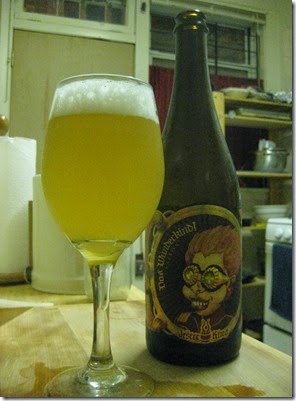
Das WunderkindBefore writing my earlier post about blending saisons and biere de coupage, I sent emails to a few of the breweries I mentioned to see if they had any advice about brewing such beers.  A few weeks after I posted, Garret Crowell from Jester King was kind enough to send me a response to my questions.  Besides asking about the beers brewed for blending, I had also asked about how the flavour profile changed as a result, and whether they blended anything with the larger proportions of old beer that Yvan de Baets mentioned in his essay. I’ll repeat part of what he said in full (and I should also mention that that there is a lot of good information in his AMA thread at TalkBeer):

At first, the blended component is subtle (at the rates we blend) but over time, further subtle fermentation takes place and can increase acidity. The most apparent evolution is the increased presence of Brettanomyces.We have done blends with higher percentages of older beer. Hibernal Dichotomous has 25% sour barrel stock blended in. As a result, the beer was more acidic from the beginning than Das Uberkind. Beyond both components of the blend being dry/done with fermentation, there aren't any special requirements for making biere de coupage. We look for a nice level of acidity in the older beer. Oftentimes, if a barrel aged beer is too sour, it can be blended out with non sour beer to balance it.

Last night J and I drank the bottle of Das Wunderkind that she bought back from her last trip to Houston, and we were both impressed by its subtle but complex mix of lemon rind and earthy funk.  Our bottle was dated back to February this year, and was only lightly tart---not much more so than an older bottle of Noble King that J picked up on the same trip.  Unfortunately she didn’t have room for more than one bottle, so we won’t get a chance to see how it ages.

Anyway, I’ve been keen to try this technique for a while, but didn’t have any pale sours on hand ready for blending. However the other day I transferred a 10 month old golden sour onto a blend of freshly frozen and dried apricots, and while racking I siphoned off around 2 litres for blending. I transferred this into a 3 gallon better bottle, and then filled it to near the top with a young saison fermented down to 1.000 with Wyeast 3711. I also added a mixed dry hop of Crystal and Triskel.

 
Siphoning off some of the old beer
The old beer was also dry (I didn’t take a fresh measurement, but last time I checked it was around 1.002), and at best moderately sour (hence the apricots!).  I didn’t taste the combined beers at blending, but I thought that at the proportions I used here---around 15% sour beer to 85% fresh beer---the tartness wouldn’t be particularly pronounced.  I was surprised, then, on bottling the beer yesterday, to find that it had a definite tartness, verging on a light but juicy stone fruit sourness.  The bitterness from the hops gave it a slightly metallic edge, but I got the same flavour in BFM √225 Saison, which I enjoyed immensely, so I’m not too worried.  Based on what Garrett Crowell said in his email, I’m hoping that the acidity will increase somewhat as the beer conditions in the bottle, and if nothing else the brettanomyces from the older beer should change the flavour profile over time.

We’ll see how the beer conditions, but its exciting to see that even such a small portion of sour beer can noticeably shape the beer’s flavour profile.  This already differentiates the technique from simply bottle-conditioning with brett, though it should hopefully have some of the same effects as the beer ages.   Later this month I’ll be cutting some fresh dark saisons with a larger proportion of aged beer (more on that in a week or two), and by the end of the summer I hope to have some more pale sour beer to use in this way.  I also have another plan, which I’ll post about some time in the next few weeks, which should mean that I eventually always have some pale sour beer on hand for blending in this manner.  All of this will enable further experimentation.

Update: Tasting Notes for the saison.

Monday, 16 June 2014

In Perpetuum: Farmhouse Ale

Transferring old beer onto dry hopsThe scale of most of the homebrew solera projects I’ve read about is beyond my means right now---I don’t have room for a barrel, and it would take me weeks to fill it even if I did.  But there’s no reason not to try something similar on a much smaller scale, and I have a couple of solera-style projects planned for this summer.  This post is about the first: a low gravity, hoppy farmhouse ale based on Jolly Pumpkin’s Bam Biere.

The original batch consists of around 4 gallons of a Bam Biere clone that I brewed at the start of the year.  The plan was to brew 5 gallons and drink it all this summer.  Although five gallons is more than my system can usually handle, I was trying to dial in a BeerSmith set up that would let me liquor down after the mash to reach the full volume for the boil.  Something went wrong, either with the BeerSmith profile or my process on brew day, and I ended up with 4 gallons of 1.042 wort, rather than 5 gallons of 1.037.  I should probably have added water to the fermenter once I realized this, but I decided to just keep the beer as it was.

Transferring fresh beer onto the baseFast forward several months, and its time to transfer the beer onto the dry hops.  Rather than doing this with the full batch, I decided to siphon off 3 gallons into a Better Bottle with the dry hops and keep the remaining gallon to cut a second beer.  A few weeks ago I brewed up another batch of the base recipe, but in keeping with the “Farmhouse Ale” moniker, I substituted grains based on what I had available: in place of the flaked barley and Crystal 80 in the original I used unmalted spelt and English Medium Crystal.  Today, after I transferred the 3 gallons of the original onto some Triskel hops, I added around 3.5 gallons of this fully fermented new beer onto the remaining gallon of the original batch. 

My process here is based closely on Ron Jeffries’s at Jolly Pumpkin (which you can now read about in Chapter 5 of American Sour Beers!), but it also fits the practices Yvan de Baets describes in his essay on historical saisons.  At Jolly Pumpkin the fresh beer is fully fermented with a sacchromyces strain before the wild organisms are added by transferring the beer into barrels that have active colonies of brettanomyces and LAB.  This should suit this pseudo-solera style project, since the low gravity of the young beer should prevent the base from getting too sour as it receives fresh batches.  My thought was that I could do a new pull every couple of months, transferring 3 gallons onto (different?) hops and replacing it with another 3 gallons of young beer brewed to a similar recipe with whatever grains I have available.  The result would be a hoppy, sour Farmhouse Ale in perpetuum!

Too much head space!That, at any rate, was the plan.  Unfortunately when I transferred the beer this morning I picked up a bit of acetic character in the base.  Since I was short on the original batch there was a fair bit of head space left in the fermenter, and I’ve definitely opened it once or twice over the last few months to see how it was getting along.  The relatively large amount of oxygen in contact with the beer, combined with the warmer temperatures in the last month or two might have provided the perfect environment for acetobacter to thrive. If that is what’s happened it may only get worse as this second beer ages.  There is still some headspace at the top of the fermenter, and the temperatures are only going to get warmer as the summer progresses (I have limited temperature control beyond my fermentation chamber, so I spend the hot Chicago summers worrying about my sour beers).  One option I might take would be to top the carboy up with another beer so that there was no headspace at all.  From reading American Sour Beers I learnt that Vinnie Cilurzo at Russian River keeps some fairly neutral low gravity beer around for just this purpose.

My original plan was to let this second batch age all summer, but if I don’t top it up what I may do instead (assuming it doesn’t all turn to vinegar!) is pull the next 3 gallons in a month or so and then make sure I have enough to completely fill the fermenter afterwards.  Since the base beer is pretty dry when it goes into the fermenter, I could probably package it on the earlier side if I used heavy bottles and took the remaining gravity points into account.  In fact, since there should be healthy colonies of brettanomyces and LAB in the base beer, it may even be done by then---based on what he says in this interview, I think Ron Jeffries only leaves Bam Biere in barrels for a few weeks.  So I guess I’ll either top it up this week, or open the fermenter again in a month and see what’s happened.

Update: The thought of ending the summer with 5 gallons of malt vinegar has been niggling at me all day.  Luckily, in keeping with my usual practice I saved and strained the left over kettle wort from the rye saison I brewed this weekend to make starters with during the week.  When I got home this afternoon I watered some of this down, boiled it briefly to kill anything that had started to grow in the wort, and topped up the carboy until it was nearly full.  The wort isn’t an exact match to the Farmhouse Ale, but it shouldn’t change the flavours much, especially in such small quantities.  Hopefully the small fermentation caused by the fresh wort will flush any remaining oxygen out of the carboy.  Of course, there’s nothing I can do about the high temperatures that will surely come this summer.

Thursday, 29 May 2014

Brew Day: Yeast Bay Wallonian Farmhouse

Bringing wort to a boilToday I brewed a batch with one of the new strains from my last Yeast Bay shipment: Wallonian Farmhouse .  I decided not to include this in my first order because I wasn’t sure if I’d like the flavour profile: “funky” is one those generic descriptions that can mean different things to different people, but one thing I do know is that I often don’t enjoy the more phenolic flavours that some brett strains give off, especially if they’re anything more than a background note (barnyard, band-aids, medicine, smoke). However after reading this post at Ales of the Riverwards, along with some other positive write-ups on HBT, I decided to give it a go.

My first thought was to use it in one of my standard pale saison recipes, but I have a lot of them on the go at the moment, so I decided to try something a little different for my first batch.  I’ve been intrigued for a while by the recipe for Saison de Pipaix in Farmhouse Ales.  The grist---58% pilsner, 40% vienna, 2% amber---is pretty different from my usual saison base of 90% pilsner and 10% wheat, and Phil Markowski’s description makes the beer sound delicious:
“Decidedly rustic with woody, fruity, iron notes on top of a malty, dryish sour backdrop.  The flavour is peppery, fruity, and dry; refreshing and pleasantly funky.  A true farmhouse ale.”
I actually bought a bottle once, based on this write up, but it was completely flat and possibly oxidized, so it went down the drain.  I’ve been wary about picking up another after this experience, so once again this is an “inspired by” beer based more on description than acquaintance.

That said, I think this yeast should be well-suited here: perhaps not for making a clone beer, but certainly for making something that fits the beer I imagine.  The blurb on The Yeast Bay website makes it sound like the strain should hit all the right notes.  First, the Farmhouse Ales recipe mentions very high attenuation, at around 92%; the Yeast Bay description says that their yeast “exhibits absurdly high attenuation, resulting in a practically bone-dry beer”. Second, Ed Markowski described Pipaix as dryish sour and pleasantly funky; the Wallonian Farmhouse strain “imparts a slight earthy funk and tart character to the beer” and is “a very mild producer of some slightly spicy and mildly smokey flavor compounds”.
The write up at Ales of the Riverwards bolstered all of this. While I’m not planning on adding any of the spices that are listed in the original recipe, Ed Coffey said of his first beer that if he told me people he’d added spices, they’d believe him.  He also said that the yeast emphasized the pilsner malt, which should work nicely with the more flavourful vienna and amber malt in the mix as well.

I decided to exercise a bit of restraint with the hops to let the yeast shine through.  The original recipe lists Hallertauer, East Kent Goldings, and Styrian Goldings, but though I had all of these on hand, I threw some Willamette and Northern Brewer into the mix to emphasize the woodsy, earthy flavours.  I gave the wort a good 40 seconds of oxygen to encourage attenuation, then set it in my fermentation chamber at 70°F. I’ll probably pull it out after 24-36 hours and let it free rise to wherever it wants to go.

Update: Tasting Notes.

Recipe:
   
Estimated O.G. 1.052
Measured O.G. 1.049
Measured F.G.
ABV.
Mash:
149°F 90 minutes
Malt:
58% Pilsner (Dingemans)
40% Vienna
2% Amber (Thomas Fawcett)
Hops:
Northern Brewer 60 23.9 IBUs (16g @ 7.5%)
Styrian Goldings 20 3.5 IBUs (15g @ 3.5%)
Willamette 20 4.8 IBUs (15g @ 4.8%)
East Kent Goldings 1 2.0 IBUs (10g @ 5.9%)
Wilamette 1 1.6 IBUs (10g @ 4.8%)
Yeast:
Wallonian Farmhouse

Saturday, 24 May 2014

Brew Day: Table Beer II

Table Beer IIThis is a beer I brewed last weekend, before the grain from the group buy arrived.  Its another attempt at a table beer---a refreshing, low-alcohol beer for everyday consumption.  Since J and I both teach and/or study most days, we need to be fairly clear-headed, which means being careful about how many beers we have in a night (even with the low-alcohol beers I normally brew).  I’d like to come up with one or two recipes for table beers that we could always have on hand: one with American hops for J, and one with European varieties for me.  Table Beer I was an attempt at the first; this is an attempt at the second.

Its loosely inspired by Jester King’s Le Petit Prince, though based more on the description of the beer than any real familiarity with it.  I had a bottle a year or two ago, but I don’t remember anything much about it.  It would have been made before the brewery incorporated their house culture of wild yeasts and LAB into all their beers, so its possible that the current iteration of the beer tastes different anyway.  J brought me back a bottle of Noble King from Houston last time she visited, and the souring bacteria and brettanomyces from the house culture were very evident in the flavour profile (it had a lovely lemony tartness, but some of the other flavours were a little strange).

Anyway, this isn’t really an attempt at a clone, but the recipe probably ended up being pretty similar to the one for Le Petit Prince.  I’ve listened to the Brewing Network interview with Ron and Jeff quite a few times, and I also watched this video---in which Jeff discusses recipe formulations---right about the time I came up with the grist and hops (warning: the video cuts out at some key points).  As a result I think the recipe is very similar, if not identical, to the one they use.  I’m relying on the French Saison yeast (WY3711) to dry the beer out completely, but also to give some mouth-feel to the finished product with the glycerol it produces.  The beer will also get a large dry-hop of Saaz in a week or two (Jeff says they dry hop at about 1lb per barrel, which works out at around 40-50g for my batch size).  As usual, the beer is also doing double-duty as a large starter for some other projects I have planned with this yeast.

Update: Tasting Notes.

Recipe:

Measured O.G. 1.024
Measured F.G. 1.000
ABV. 3.0%
Mash: 149°F
Malt:
84.7% Pilsner
13.2% Wheat Malt
2.0% Medium Crystal      
Hops:
EKG 60 min 11.8 IBUs (10g@ 5.9%)
EKG 10 min 3.5 IBUs (15g@ 5.9%)
Saaz 10 min 1.2 IBUs (10g@2.9%)
EKG 0 min 0.0 IBUs (15g@5.9%)
Saaz 0 min 0.0 IBUs (10g@2.9%)
Saaz Dry Hop (40g@2.9%)
       
Yeast:
Wyeast French Saison (3711)


Sunday, 20 April 2014

Brew Day: 1909 Lees Bitter (plus invert sugar)

Hops and Invert No.1I should have a number of posts with tasting notes coming up in the next few weeks, but  I haven’t decided whether I’m going to post here about every brew day.  Since I’m focusing more and more on particular kinds of beer, posting all the time might become repetitive.  However I think there’s enough that’s different about what I’m brewing today to warrant a post.

The beer will be another bitter, using the London Ale III yeast that I top-cropped from the ordinary bitter I made last weekend.  I took the recipe from Ron Pattinson’s new book: The Home Brewer’s Guide to Vintage Beer.  Its a nice little volume, with brief but informative histories for a number of British styles (often correcting widespread misconceptions), along with a range of recipes that Pattinson has reconstructed from old brew logs.  The format is similar to the “Let’s Brew” posts on his blog, though sadly missing Kristen England’s helpful notes and directions.

The recipe I picked was for a 1909 version of J.W. Lees Bitter (a beer still made in Manchester today, though, as Pattinson shows, the recipe has changed many times over the last century). Pattinson suggests using London Ale III in this beer, but what really caught my eye was the large proportion on invert sugar (~18%), along with the relatively large amount of hops all added before the last 30 minutes of the boil.  These features set the recipe apart from most contemporary home brew efforts, where for a long time the conventional wisdom has been to avoid large quantities of sugar, and to preserve hop aromatics by saving some additions for the last 15 minutes of the boil.

Needless to say, I’m very curious to see how this one turns out.  With such large hop additions I expect some flavour to carry over into the final beer, even if these aren’t what we typically consider flavour additions.  The large quantity of low alpha hops will also shape the character of the bitterness: I often get a tannic, tea-like quality when I bitter in this way (although I’ve never done it on this scale before).  I’m a little sorry that I’ll be using US fuggles rather than the English variety, but its what I have on hand.

Making Invert SugarA quick note on invert sugar, for those who have never used it before.  Its fairly easy to make (Pattinson gives instructions in his book, and you can also find them online), and definitely affects the flavour profile of the final beer.  This will be my first time using invert number one, but I’ve made invert two a few times.  There are two things I’ll mention about the process.  First, make sure you use an unrefined sugar like demerara or turbinado.  These are fairly common back in the UK; ‘brown sugar’ in the US is something different, usually just white sugar blended with molasses.  Second, be careful as you ramp up to 240°F.  Its very easy to overshoot, and I’ve had a lot of difficulty keeping the temperature below 250°F.  My syrups are always fairly viscous and slow-moving---this is easily handled with a hot water bath, but I wonder if it is a result of letting the temperatures get too high.

Post-brew update: another low OG!  This might be because the invert is contributing less extract than BeerSmith expects, but I think I may also need to adjust my boil-off rate (plus there’s the age of the malt).  Usually a few points either way don’t matter, but with this much bitterness, being almost 10 points low is sure to make a big difference.  On the plus side, I transferred the ordinary bitter from last week and its tasting really nice so far.

Recipe:

   
Estimated O.G. 1.055    
Measured O.G. 1.046 (Low!)  
Predicted F.G. 1.010    
ABV. 5.82%    
IBUs 70.3    
       
Mash:      
  154°F 80 minutes  
       
Malt:      
81.8% Maris Otter      
18.2% Invert No. 1      
       
Hops:      
Fuggles (US) 60 min 46.6 IBUs (57g @ 4.1%)
Fuggles (US) 30 min 23.8 IBUs (57g @ 4.1%)
       
Yeast:      
London Ale III      

Sunday, 23 March 2014

Brew Day: Belgian Dry Stout

I’ve brewed a few times in the last two weeks, using the pitch of 3522 that figured in this post about top-cropping.  The yeast I cropped there was for an experimental recipe: a belgian dry stout.

IMG_1719[1]This is another beer inspired by Yvan de Baets and Brasserie de la Senne, but this time I decided to brew this recipe even before I tasted the beer that is its inspiration.  I have a slightly strange habit of trawling through brewery websites to read descriptions of beers I’ve never tried.  They often give me ideas for recipes, and it fits with the general idea of trying to make beers that I know I’ll enjoy without deliberately setting out to clone any particular commercial example.  I’d already heard Yvan and Bernard describe the beer in this video from Shelton Brothers, and the description of Stouterik on the brewery’s website was enough to pique my interest further: light, dry, and freshly bitter with complex roasted notes.

I decided to take a typical recipe for a dry Irish stout and ferment it with the Wyeast Ardennes strain.  This has a fairly subdued character if fermented in the 60s, and can add a slight tartness that I thought would complement the style.  The only other change I made was substituting chocolate for some of the roasted barley.  This changed the colour slightly, but I hope it will add to the complexity of the final beer.

One thing that struck me as I formulated the recipe was how similar a basic dry stout is to the saisons de Baets describes in Farmhouse Ales (see quote in this post).  Obviously dry stouts are dry(!), and have relatively low alcohol.  They are heavily bittered with a large dose of low alpha hops, and contain a substantial amount of adjuncts in the form of barley or wheat.

SAM_1797After formulating the recipe, I had to wait a few weeks before brewing, and in that time I had a chance to pick up a few bottles of Stouterik (along with a very different Belgian stout, Drie Fonteinen’s Zwet.be).  The De la Senne beer is lovely: dry and slightly fruity, with a subtle roastiness and firm bitterness, neither of which make it acrid or astringent.  It has some dark fruit notes, which makes me wonder if there isn’t also some crystal in their beer (it may also be their yeast).  Perhaps next time I’ll add 1-2% dark crystal or Special B to bring this out.  The Drie Fonteinen beer was also enjoyable: it had a fairly light, grapey sourness, some chocolate and roast notes, and that slight but distinctive burnt rubber aroma and flavour that this brewery’s beer often seem to have.  As it warmed it began to taste like a slightly sour chocolate, and the grape notes became more like currants or red fruits. Unlike the De la Senne beer, its not something I can imagine drinking regularly, but I’d certainly buy it again.

Anyway, below is the recipe as I brewed it.  This is a work in progress, and I expect to come back to it again based on how this one turns out.  Now that I’ve tasted Stouterik, I don’t think this will be much like it---I don’t think their yeast is the Ardennes strain, for instance, and for some reason I have in mind that their “English aromatic hop particularly appreciated by connoisseurs” is Challenger rather than Fuggles. But I think this recipe will provide a good starting point for further development.  If I decided I want to make it more like the original, I can always culture yeast from a bottle and tweak the recipe.  

Update: Tasting Notes.

Recipe:
   
Estimated O.G. 1.040    
Measured O.G. 1.037    
Measured F.G. 1.009    
ABV. 3.7%    
       
Mash: 150°F    
       
Malt:      
69% Maris Otter      
20% Flaked Barley      
8% Roasted Barley      
3% Chocolate      
       
Hops:      
Fuggles 60 36.8 IBUs (45g @4.1%%)
Fuggles 10 1.8 IBUs (10g @ 4.`%)
       
Yeast:      
Wyeast Belgian Ardennes (3522)