Monday, 6 July 2015

Tasting Notes: Wheat Beer w/ Wyeast Brett. C

Here's some tasting notes for a beer I made with Wyeast's Brettanomyces Clausenii strain during its Private Collection release this spring.  To be honest, I'm no more or less interested in single-strain brettanomyces fermentation than I am in other pure cultures, which is to say that if I like the results I'll come back to a strain over and over again, but given the beers I tend to brew these days I'm quite happy with the English and Belgian strains I have in regular rotation.  In fact, now that Brett Trois has been outed as a saccharomyces strain in disguise, I can't have done more than a handful of all-brett beers over the past few years.

Of course, I'm very interested in what brettanomyces can contribute to mixed-culture fermentations, and I like to have various strains on hand to pitch into my beers.  The main reason I brew all-brett beers these days is because the bottle dregs provide an easy way of dosing other beers during fermentation. (I keep some half gallon jugs of strains I like going in my brew closet, but its generally easier to just drink a beer and pitch the dregs.)

After buying a packet of this yeast I wasn't sure what to do with it.  My ultimate goal was to use it to dose English stock ales for a traditional mixed fermentation, but I'm not planning on brewing any until the Autumn.  In the meantime I figured I could use it as a secondary strain in some saisons, and perhaps see what it was like fermenting a beer by itself (if only to use the bottle dregs later in the year).

Wheat beers seem like an obvious choice with brettanomyces, since their soft and fluffy mouthfeel can compensate for the fact that brett strains tend to produce less glycerol than their more familiar sacch. cousins.  I had a bunch of old but well-kept Galaxy hops, and a couple of citrus fruits (didn't note the variety but I think they were clementines), so I decided to throw it all together for a spur of the moment witbeer.  My original plan was to cut it with some no-boil sour to give it a slight tartness, but I didn't have enough heavy bottles to package it, so I didn't want to risk starting a secondary fermentation in the bottle.

The recipe was based loosely on this beer from Michael Tonsmeire's site, with the citrus and Galaxy hops thrown into the whirlpool.  The O.G. was 1.044, and the F.G. seemed to settle around 1.008.  I packaged the beer relatively quickly since the gravity remained stable over a whole week, but I was worried that putting the beer under pressure might start another fermentation.  It reached its apparent terminal gravity fairly quickly (within three weeks).  You can find plenty of people online stating that this isn't uncommon for brett beers, but most of them are talking about Trois, and the most recent interviews I've heard with Chad Yakobson suggest a primary fermentation with brettanomyces can take a little longer and go through a number of stages.  But I knew I was going to be drinking the beer quickly, so I aimed for a fairly low level of carbonation and hoped for the best.  The beer is about two months old at this point, and its carbonation has been consistent since bottling.

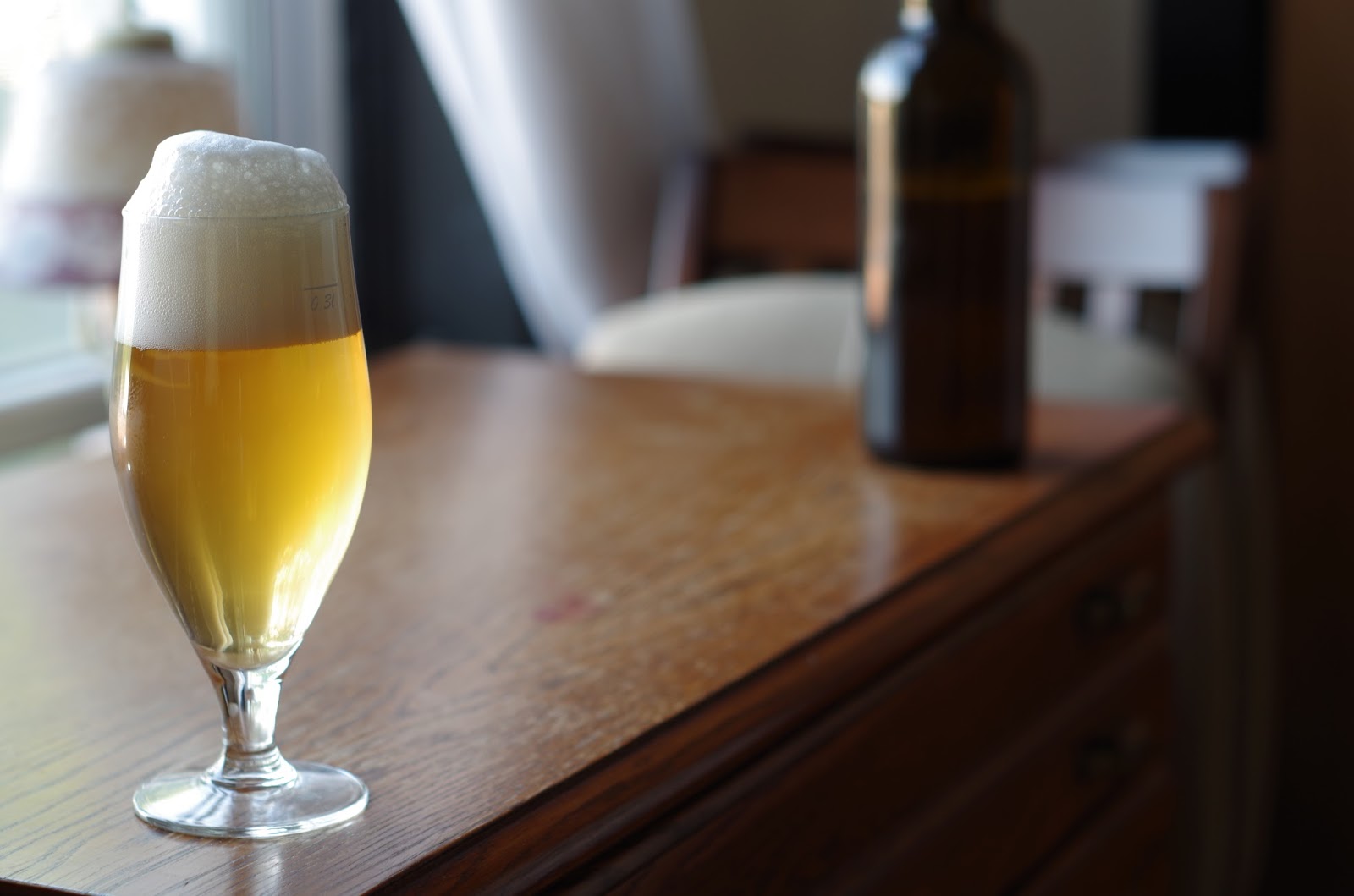
Appearance:  Soft yellow colour.  You can see a spiral of yeast because I wasn't careful with my pour.  Head recedes to about half an inch then lingers for most of the time I'm drinking it.

Smell: Unpleasant whiff of eggy sulphur when I first pour it.  As that dissipates a bit there's a lingering aroma of wheat and sweet oranges.  Maybe the slightest hint of musty funk, but could just be the sulphur.

Taste:  Clean wheat rounded out by a soft fruitiness.  Neither the hops nor the citrus are as pronounced as I expected.  Very subtle and smooth.  Light but lingering bitterness that might be from the citrus rather than the hops.

Mouthfeel: Very low carbonation, and a bit on the thin side (though not at all bad for a brett beer).  Still quite refreshing and drinkable.

Drinkability & Notes:  This was a bit of a throwaway beer.  I had the packet of yeast and didn't have any particular use for it, so I decided to brew something quick that I might enjoy drinking in the summer.  The result was a surprisingly clean wheat beer.  Nothing special, but perfectly enjoyable, thought the sulphur is a little unpleasant.  I think either blending it with some sour beer, or dry-hopping (or both!), along with increasing the carbonation, would have made it stand out more.  I managed to package a few in heavy bottles for longer-term ageing (though over carbonation is certainly not an issue so far).  As I mentioned above, this is mainly so I have an ready source of Brett C to dose other beers with, but it will also let me see how this changes as it ages.

Sunday, 28 June 2015

Tasting Notes: Saisons w/ Yeast Bay Saison Blend

As you might have already noticed, posts to this blog are going to be a bit more infrequent over the summer.  I'll try to schedule a few tasting notes posts for while I'm away in England, and I'll post any interesting beer related activities over on the blog's Facebook page.  Since I'm going to be posting less frequently, I've decided to try to combine various beers together into longer posts.  Here we have a couple of beers brewed with The Yeast Bay's saison blend.

This is the second time I've used this blend in an almost identical series of beers, and I have to say that overall, I'm a big fan.  It reliably delivers a 'classic', yeast driven saison profile that I think works very well for clean saisons.  It ferments relatively quickly, and seems to get beers reasonably dry as well.  Both these finished at around 1.004.  I can usually get them lower with Wyeast 3726, and in future if I brew these again I would change the the bitterness slightly to balance the higher F.G.  One thing I have noticed is that, at least when I've used it, the blend seems to put out a lot of sulphur in the second generation.  This doesn't seem to be unusual in saison yeasts (Wyeast 3724 did the same), and it usually dissipates before bottling, but it can be a bit unnerving if you're an air-lock sniffer like me.

After the tasting notes I've posted some thoughts about the carbonation and head-retention in these beers.  As I noted in my last post, I've made a number of changes to my saison brewing process over the last few months, so I'll try to include reflections on these in my tasting notes.  Here, because I was trying out a new camera, I took a range of photos over a short period of time, so I was able to record how the head dissipated on the beer.

Spelt Saison with Saphir Hops

This beer was based on previous recipes I've made using large quantities of low AA hops---in this case, 4oz of Saphir rated at 1.8%, supplemented with some Hallertau for bittering, all in a three gallon batch.  I generally prefer to get bitterness from large doses of low AA hops, in part inspired by Yvan de Baets descriptions of the hopping rates in old saisons, but also because I find it gives a pronounced bitterness that is rarely astringent or biting.  I suppose I should worry about getting grassy tastes from having so much vegetal matter in the boil, but I have never noticed this, at least not to any degree that I find unpleasant.  I think the spelt also helps to soften the bitterness by rounding out the mouthfeel slightly, which prevents the beer from tasting too sharp.  This recipe included 30% unmalted spelt in the grist.

The O.G. was 1.040, and the F.G. around 1.004, giving an ABV of 4.6%.  Given how rounded and soft the beer tastes, I think I could happily drop the O.G. down into the 1.030s, aiming to produce a beer around 4%.


Appearance:  Pale golden colour.  Billowing head on pouring that recedes to about half an inch after a few minutes.  (More on that below.)

Smell:   Distinctive yeasty 'saison' smell that I'm having trouble describing fully: it reminds me a bit of North Coast's Puck.  A bit of grapefruit and general citrus, very light peppery spice, and maybe a hint of plastic.  Lovely smell: the hops accentuate the yeast blend nicely.

Taste:   Slightly sweet up front, then grapefruit zest and white pepper.  Really nice, but then it finishes a touch too sweet for me.  The spelt adds a slight savoury note, which I want to try to make more pronounced in future, in line with what you see in Brasserie Blaugies beers like Saison D'Epeautre and La Vermontoise.

Mouthfeel:  Prickly carbonation with a round soft mouthfeel thanks to the spelt.   What lingers is a slight sweetness rather than the gradually building bitterness I'm looking for.

Drinkability & Notes:  As I mentioned above, both these beers finished a few points higher than I would have liked (though still drier than many other beers), and unfortunately this translates into a slightly sweet and cloying character.  Ideally I'd get round this by having the beer attenuate a few more points, but I think a more pronounced bitterness, accentuated with some gypsum, might have the same effect.  The blend definitely delivers in terms of classic saison character, and works nicely with the Saphir hops.

Classic Saison with Crystal and Sterling Hops

This beer is a version of the Classic Saison recipe from Farmhouse Ales, but with American hops subbed for the European varieties suggested in the recipe.  The grist was 90% pilsner and 10% wheat, and the O.G. was 1.050, higher than I usually go for my saisons.  With an F.G. of 1.004, this gave me 6% ABV.


Appearance: Standard golden colour, with a rocky head that dissipates to about a half inch.  Moderate lacing.  (Again, more on this below.)

Smell:  Same 'classic' saison character, but more subdued here.  Grapefruit is there but not as prominent, and I also get a bit of blackcurrant too, with less peppery spice.  Its all supported by a sort of musty, earthy funk---I don't know if this is from the hops, or if the beer picked up some brett from my saison equipment.

Taste:  Zesty, peppery saison character, but not as pronounced as it was in the other beer.  Transitions to that slightly musty funk along with a light bitterness at the end.

Mouthfeel:  Not as rounded as the spelt saison, despite that fact that it had a higher O.G.  Crisp and quite dry, with enough bitterness to balance the beer but not enough that it asserts itself.

Drinkability & Notes:  A fairly enjoyable spin on something like Saison Dupont, though not a clone by any means.  The slightly musty character detracts from the overall impression for me, perhaps because its not what I was going for. though its probably more subtle than these notes suggest.  The beer is crisper and more refreshing than the spelt saison, but I'm more excited about brewing modifications of the latter.

Step Mashing, Adjuncts, and Carbonation

These beers reflect a couple of the changes I've made to my process over the past few months.  First, both were made with a step mash that included a protein rest in the low 130s.  I didn't use an under-modified pilsner malt, but obviously the first beer contained a significant amount of unmalted spelt (30% of grist).  I think in this case I added the cereal -mashed spelt after the protein rest to get the beer up to the first saccharification rest, which might be the wrong way to do this (i.e. perhaps the spelt should be in the mash during the protein rest).

I also carbonated both beers to approximately 3 volumes (this works out at a convenient 100g of sugar per batch for me).  Its also worth nothing that both beers, but especially the spelt saison, had a lot of hop matter added in the boil.

Together these changes have yielded a definite improvement in the appearance of these beers.  Both had billowing heads on pouring, and there was some retention at around five minutes after pouring, as you can see from this sequence of photos.


The beautiful rocky head in the picture of the Classic Saison came from topping up the beer after the initial pour.  I'm not sure why exactly, but I think I've noticed this happening before: the first pour billows and dissipates somewhat, whereas the second sticks around and rises above the top of the glass.  My memory is that the Classic Saison had slightly better head retention, settling at over half an inch, and the pictures below seem to confirm that (though I wasn't particularly careful about the times,  and the different glass might also have supported better head retention).


As I said above, overall I'm much more excited about the Spelt Saison, even though the Classic one came out a little better this time round.  Its partly because I just prefer beers with lower alcohol, but also because I know that with a bit more bitterness to balance the slight sweetness from the rounded mouthfeel and higher than normal O.G., it will make for a really pleasant everyday beer.

Monday, 25 May 2015

Brewing Saisons: Some Thoughts on Process

I've brewed a lot of beers since April, most of them saisons, but as the temperatures start to get hotter and the school year wraps up, I'm starting to think about stopping brewing for the summer.  This is partly because I'll be going back to England for a month, but also because brewing in a hot and humid apartment is just not much fun.  I'm sure I'll fit in a couple of batches, but the next proper series of beers I have planned will be the top-ups for my soleras in preparation for a blending project at the start of the Autumn.

I'll probably find time to post here occasionally---I need to write tasting notes for a number of batches---but I'll be updating this blog's Facebook page more often than I write posts here.  I'm hoping I'll find time to go through some more old brewing texts, and I'll post anything interesting I find on that page.

Rather than write up brew day posts for the saisons I've been making recently, I thought I'd write a post summarizing some of the changes I've made in my brewing process during this most recent round of saisons.  This isn't supposed to be a general overview of saison brewing---for that, I can't think of a better guide than this post at Spontaneous Funk---but rather a summary of some of the changes I've made that might be of interest to anyone trying to brew lower gravity saisons (many commercial versions come in at 6% ABV or higher, whereas I aim for 4-5% ABV).  I'll come back to these points as I write tasting notes this summer, and try to see what kind of effect they have on the final products.  When I start brewing again after the summer, I'll be focusing more closely on water chemistry and pH during my brew day process, which will probably lead to a few more changes.

1. Carbonation

I'll start with one of the more obvious ones: aiming for a higher level of carbonation, somewhere around 3 volumes.  This probably seems obvious to anyone whose drank a lot of commercial saisons, since many if not most have fairly spritzy carbonation.  But the truth is, I didn't really start brewing these beers in emulation of commercial versions.  Instead I was captivated by Yvan de Baets' description of historical saisons in his essay in Farmhouse Ales, and set about trying to brew the kinds of beer he described.  My frame of reference was therefore a bit limited: I knew I liked Saison Dupont, but I hadn't tried many other Belgian versions beyond the beers from De La Senne and De Ranke, and I didn't like the bigger American saisons I'd had at that time.  This meant I took my starting point from the bitter, low alcohol English beers I'd been brewing up to that point (part of what intigued me in Yvan's essay was that the beers he described seemed to combine the best parts of bitter, with the complexities of lambic), and that meant aiming for a lower volume of CO2 in order to prevent the beer from seeming harsh and thin.

I still tend to prefer lower levels of carbonation in most beers, but after drinking many more Belgian saisons I want to try to capture the striking appearance these beers have when they're poured, with those thick moussey heads rising inches above the glass.  Higher levels of carbonation seem essential to acheiving this, so I'm going to aim for at least 3 volumes of CO2 for a while to see how I like the results.  (This is a little inconvenient as I don't have enough heavy bottles in rotation to package every beer, even after a recent group buy for champagne bottles.)

2. Cereal Mash With Unmalted Adjuncts

These next two points follow on from the last.  Higher carbonation risks making the beers seem harsh and sharp, at least to my palate, especially when dealing with the low alcohol saisons I like to brew.  My thought is that one way around this might be to include large volumes of unmalted grains in the grist to provide some mouthfeel and body.  Saison lore has it that farmers would use whatever unmalted grains they had available in their beers, and as I've mentioned before I usually have grains like spelt on hand for baking bread (I've started buying buckwheat explicitly for brewing, but I'll probably try baking with it soon as well).

Most of these grains require a cereal mash, which is a bit of a nuisance and certainly lengthens my brew day.  I could probably achieve something of the same affect by using flaked adjuncts like wheat and oats, but this would limit the grains I could use, and I also wonder whether the unmalted grains don't make a more distinctive flavour combination than their malted or flaked counterparts.  I love the savoury smells you get from a cereal mash with spelt or buckwheat, and I'm hoping some of that will come across in my beers (as I think it does in commercial beers like Saison D'Epeautre or Duchessic).

3.  Step Mash With Protein Rest

In his article on brewing saisons, Joe Stange suggested that including a protein rest and using undermodified malts might be key to achieving the thick head characteristic of beers like Saison Dupont.  I've been roughly following the schedule described in Farmhouse Ales, with protein rests at 113 and 131 (I often skip the first one), and then longer rests in the mid 140s and 150s. Since I'm doing a cereal mash anyway, its pretty easy to use this hot porridge to speed up the transition between steps, and the adjuncts should provide plenty of extra protein.  (I suspect that ideally the adjuncts should be in the main mash for the protein rest, whereas its more convenient for me to add them back to the main mash to get from the low 130s to the 140s.  I've tried both ways, and I'll try to note any obvious difference in the results).

4. Oak and Fermentation

This is another idea to improve the mouthfeel and overall flavour profile of my beers, inspired largely by listening this this old interview with Shea Comfort, in which he talks very knowledgeably about the uses of oak in fermentation.  One big takeaway is that judicious use of oak can improve the structure of a beer, rounding out and accentuating certain elements of its flavour profile, while also prolonging its life-span.  Comfort talks about different ways of using oak cubes, but the one that caught my attention was adding them for primary fermentation.  This seems to lead to a more subtle contribution, as many of the compounds associated with oak (vanillin in particular) are processed by the yeast during primary fermentation.  The hosts of the show taste three of Shea's beers in the final segment, the first of which is a Belgian beer fermented in  with oak cubes in the primary, and everyone seemed to agree that the contribution of the oak was very subtle, to the point where you might not even realize it had been used (unless you recognized its other effects).  This sounds like exactly what I'm looking for, and also echoes some comments I've heard certain brewers make on The Sour Hour about the contribution barrels make to their beer (i.e. that its not about tasting oak).

For now I've started experimenting by adding between 10-15 grams of freshly boiled oak cubes to the wort along with the pitch of yeast (only in one beer so far---hopefully in another if I find time to brew this week).  I'll see how I like these results, and if it works well I may start doing this regularly with most of my saison-style beers.

5. Yeast Blends and Cell Counts

I've covered this already in an earlier post.  Unfortunately two of those beers spent a bit too long in primary fermenters that allow in a lot of oxygen, and they may both have unacceptable levels of acetic acid.  I'll make that call in the next few weeks.  But I used one of the blends in several beers, so I'll have the opportunity for some comparison.  Since I'm probably done brewing for the next few months I might not get a chance to use them again, but if I like the results it won't be too hard to recreate them.

One thing that's come out of making these blends is that I'm gradually getting more comfortable with using my microscope to perform cell counts.  I did this for the last few saisons that I brewed, using the calculator at Mr. Malty to get an ideal pitching rate and then measuring out the requisite amount of each slurry after performing a cell count.  One thing that was striking here was how little slurry I needed, relative to what I'd been pitching before,  Overpitching isn't the worst thing you can do to a beer, but it may have had an effect on the way the yeast expressed itself, so I'm curious to see what difference this has.

Friday, 8 May 2015

Saison Yeast Blends

As anticipated, after a vigorous start to fermentation my saison brewed with the Wyeast version of the Dupoint strain stalled at around 1.030, and has been slowly attenuating further ever since.  I'm in no rush, so I'm happy to leave it for another few weeks until the yeast drop out of suspension.  If its not dry enough at that point, I'll add some brettanomyces and let it age for another few months, but based on other people's experience with the strain I don't think that will be necessary.

All of this made me even keener to try out my own yeast blends, using the Dupont strain along with other organisms.  It seems that people generally agree that the 'leaven' at the Dupont brewery consists of a number of different strains (including wild yeast), and I've read plenty of interviews with U.S. brewers who like to use the Dupont strain for its flavour profile, but pitched along with another strain to ensure a fast and reliable fermentation.

So I knew I was going to make a blend of at least two yeast strains.  The question now was what I should pitch along with the Wyeast Dupont strain.  Wyeast French Saison strain (3711) seems to be the most common choice here, since it ferments quickly and produces a very dry beer, albeit with some residual mouthfeel due to its high glycerol production.  I've pretty much sworn off using this strain because I don't really like its flavour profile (which means I don't like a lot of American saisons!).  Perhaps it would express itself differently as a small proportion of a blend, but since I already had a pitch of Wyeast 3726 on the go, I decided to use that instead.  This is reportedly a version of the Blaugies strain, which in turn is supposed to originate from the Dupont brewery.  All the more reason to use it in the blend then, especially since it reliably attenuates my saisons to within a few points of 1.000, and produces a flavour profile I quite enjoy.

I settled fairly arbitrarily on a blend of 70% Dupont to 30% Blaugies.  My thought was that this would be a large enough proportion of Dupont that it would dominate the flavour profile, but with enough Blaugies that it also contributed some complexity along with taking over in the second half of the fermentation and ensuring the beer dried out in a reasonably short time frame.

Both yeasts came from the cakes of recent saisons.  I got out my copy of Yeast, along with a microscope that I purchased second-hand thanks to a fellow brewer who runs one of the labs on campus, and had a go at serial dilution and yeast counting to work out how many cells I had per ml in each cake.  I'm not completely confident in my procedure here, so I won't write it up (I followed the instructions in the book, diluting the yeast by a factor of 1000, counting the number of cells I could see on a hemocytometer, then working from here to a number of cells per ml).  Based on these numbers I measured out three pitches of roughly 100 billion cells, a slight overpitch given that each was going to be 12 litres of 1.040 wort, but I hadn't taken the viability of the cakes into account in my original calculations, and I figured it would be better to overpitch than underpitch.  Interestingly enough the final blends contained smaller slurries than I usually pitch, which means I've been overpitching by a significant factor for a while now.  I got a quick start to fermentation, which suggests I didn't mess up the count too much, so as I become comfortable with this process I'm going to use it more frequently to determine the volume of yeast I re-pitch.  (Incidentally, you don't need a microscope to come up with your own blends: check out Dave Janssen's procedure here.)

So now I had three pitches consisting of 70% Dupont and 30% Blaugies.  But what about the 'wild yeast' the Yvan de Baets says Dupont keeps in their leaven to ensure complexity?  The Wyeast 3726 has been through several generations in my saison equipment (i.e. scratched up buckets that have had plenty of brettanomyces in them), so there's a good chance its already not a pure culture.  I decided to keep one pitch as it was, with just these two strains.  For the second, I added about 20ml from a fermenting starter of the recently released Wyeast Brettanomyces Clausenii; and for the third, I added half a vial of The Yeast Bay's Amalgamation blend.

Three pitches, three saisons.  If I were a proper blogger I'd probably have pitched each blend into an identical beer to compare the results, but its not easy to make enough beer to make that worthwhile on my set up, and I wanted some variety anyway.  Instead I compromised, brewing three beers with the same grist but using different hops in each one.  The grist was mainly pilsner with a little bit of golden promise and malted wheat, aiming for an O.G. in the low 1.040s.  I picked the hops fairly arbitrarily based on how I imagined the final beers tasting, in each case going for a 2:1 blend for everything except the bittering addition (60, 20, 5, 0 minutes).  Here's what I ended up with:

Dupont/Blaugies saison: blend of Crystal and Sterling.

Dupont/Blaugies/Brett. C. Saison: blend of East Kent Goldings and First Gold.

Dupont/Blaugies/Amalgamation Saison: blend of Huell Melon and Hallertau Blanc.

I brewed all three batches last weekend, keeping each beer below 70 for the first 12 hours of fermentation and then allowing them to rise from there.  I haven't taken any measurements, but fermentation started quickly and each beer has been more active than the saison pitched with Dupont alone.  I'll rack them to secondaries over the next few weeks (all my carboys are tied up at the moment), and at that point I'll take measurements and make decisions about bottling timeframes.  I'm hoping to get them packaged in the next month or so, so that they can condition while J and I take a trip back to the U.K.  So, expect tasting notes in a few months!

I'm hoping to repitch each blend at least once as well: it will depend on (a) how each beer tastes when I rack it, and (b) how much brewing I get done before we leave.  Right now I'm thinking I'll use the Amalgamation blend in a version of my Buckwheat Saison (and cut it with the final gallon from my first pull of the Roeselare Solera); split the Brett. C. cake between a bitter spelt saison and a saison fermented with LAB along with the blend; and use the Dupont/Blaugies cake in a petite saison made with wheat and/or spelt (a 'grisette', if you insist).


Saturday, 2 May 2015

Spontaneous Fermentation II: Success?

After my failed attempt at spontaneous fermentation in November, I was itching all winter long to have another go once the snow left and the temperatures rose above freezing.  It took a little longer than I anticipated (Chicago winters don't give up without a fight), but at the start of April I finally had another chance to have a try at it.  My process was essentially the same as last time: I let the wort cool by an open window overnight, and then transferred it to a carboy along with an oak spiral that had been sitting in a gallon jug containing my 'house culture'.  There were at least three significant differences that might have affected the outcome this time round: the oak spiral had been sitting in the culture for several months, instead of for a few weeks; the temperatures overnight stayed well above freezing; and I was able to give the wort an extra hour or two to cool, though it was still in the high 70s when I transferred it the next day.

Last time the wort sat for almost ten days without showing any signs of a strong fermentation.  A thin white pellicle formed after a few days, and remained there for the next week, but when I finally took a sample the gravity had barely dropped at all, and the pH was still dangerously high at 4.9.

This time, after only two days, a thin krausen formed on top of the wort.  Within a day or so, this was more than an inch thick, composed largely of small fine bubbles that looked like bubble bath (the second photo is from day five).  The krausen stuck around for a while, dissipating briefly, then flaring up again a few days later.  At this point the aromas coming from the airlock were slightly vegetal and gross, after seeming fairly clean for the first few days.

Eventually, once things had settled down a bit (approximately two and a half weeks after fermentation started), I transferred the wort to a smaller carboy and took some measurements.  The pH was at 3.96, and the gravity at 1.022, so I knew it should be safe to try a sample.  To my surprise, it didn't taste that bad!  Slightly tart, with a predominantly doughy character and some vegetal notes.  Not something I'd enjoy drinking in any great quantity, but also not something I wanted to spit out at once.  I count that as a success.

Transferring the beer to a secondary provoked another round of fermentation, which has continued up till today (a month after I brewed it).  I don't want to take enough wort for another gravity sample, but I did sneak another taste.  The vegetal aroma is still there, and the taste is a strange combination of slight tartness, sweetness, and bitterness from the aged hops.  I expect this to change significantly as it ages, and at this point I'm planning on essentially forgetting about it for the next year (who am I kidding, I'll probably sample again before then, but I'm going to at least try to leave this one alone).

Sunday, 19 April 2015

Brew Day: Saison w/ Wyeast 3724

As I mentioned in my last post, I'm back to brewing saisons at the moment, and this weekend was no exception: two different beers over two days.  One was essentially a re-brew of my bitter spelt saison, this time using large quantities of Saphir hops along with a re-pitch of The Yeast Bay's Saison Blend.  I've posted about all of this before---the unmalted grains, the large amounts of low AA hops, etc.---so I thought I'd write a post about the second beer I brewed this weekend instead, a saison using the infamous Dupont strain.

This will be my first time using Wyeast 3724.  Its reputation as a difficult strain scared me off when I first started brewing saisons, and once I found other strains I liked and could work with (Wyeast 3726 in particular) I didn't feel any urgent need to try it out.

But about a month ago I picked up a few of the brown bottles of Saison Dupont (these are fairly new to the US market), and figured I might as well try to grow up some yeast from the dregs.  I proceeded much as I did with the De La Senne dregs, pitching the last few centimeters of beer into about 50ml of 1.020 wort, and spinning this on a stirplate for a few days.  I saw some activity, and posted about my plans on a Facebook group dedicated to saisons and related styles.  I'm glad I did, because someone who works for the US importer of Brasserie Dupont commented on my post and told me that they filter the beer and use a different strain for bottling, which meant I was unlikely to get the yeast I wanted by growing up the bottle dregs.

In the meantime, though, I'd been rereading the sections of Farmhouse Ales about the Dupont strain in preparation for brewing with it.  One thing that had caught my eye before was Yvan de Baets claim that the "leaven" at the Dupont brewery (cultivated since 1950!) is "composed of several yeast strains, of which at least one is 'wild' in order to conserve the complexity of their beers".  I asked the US importer about this, and he confirmed that it is "more or less a 'culture' of different yeast strains some being wild".  I'd been thinking about trying to come up with some yeast blends myself for a while, after reading posts by Michael Thorpe and Dave Janssen about their experiences with blends, and this spurred me on to buying a packet of Wyeast 3724 to use it in my own blends.

But more on that in a later post.  Since I now had a Dupont strain on hand, I couldn't pass up the opportunity to see first-hand just how this yeast behaves as a sole fermenter (if only because brewing a batch would give me plenty of yeast to use in blends).  My plan was to put it through my usual saison fermentation regime: pitching in the mid 60s, putting the wort in my fermentation chamber set at 70 for 12-24 hours, then letting it free-rise to wherever the yeast wants to take it (usually somewhere in the mid to high 70s, I'd guess).

People seem to like pitching this strain into warmer wort, and keeping the fermentation temperatures on the high side, even up into the 90s.  Markowski mentions that the Dupont brewery does something similar, with fermentation taking place between 85 and 95°F, but he also mentions that this is more of a production concern, ensuring a swift primary fermentation: "the yeast delivers plenty of character at 75 to 80°F, but fermentation takes much longer".  I'm in no rush, so I don't mind giving the beer a month or two to finish fermenting.

I went with a fairly standard grist, mainly pilsner with a little bit of wheat to help with head retention.  I decided to go for a slightly higher gravity than usual, aiming for something closer to Saison Dupont with an O.G. in the mid 1.050s, rather than in the 1.040s where most of my saisons end up.  I'd also like to imitate the thick and mousse-like head that Dupont gets on their beers, so to help with this I added a protein rest at 130°F along with longer rests in the mid 140s and 150s.  The hops were a blend of EKG, Styrian Goldings, and First Gold, with additions at 60 minutes, 15 minutes, and 2 minutes before the end of the boil.

An interesting tidbit from Markowski's book is the speculation that the Dupont yeast may have originally been a red wine strain, accounting for its preference for high temperatures and its ability to produce hydrolyzing enzymes to (slowly) break down complex sugars and ensure a high degree of attenuation.  One useful tip Markowski provides is to add some DAP to boost the free amino nitrogen levels in the wort, since wine strains typically need higher levels than most ale yeasts.  I had some on hand and had every intention of using it, but I completely forgot about this until I was cooling the wort, and decided not to risk adding any at that point.  I did take other steps to ensure a healthy fermentation however, getting a very fresh packet of yeast from Ritebrew's preorder system, making a small starter to ensure the yeast was active at pitching, and making sure I gave the wort a big dose of oxygen.

The wort is currently sitting in my fermentation chamber at 70°F.  I'll turn of the fridge tomorrow and let it rise as high as it likes.  I'm using one final tip from Drew Beechum, who speculates that what causes the strain to stall is "increased pressure and CO2 levels created by an airlock or blowoff tube", and suggests avoiding this by practicing a semi-open fermentation.  I don't know how plausible that is, but I've done plenty of semi-open fermentations before and often don't bother with an airlock for the first few days of primary fermentation anyway.  This time the carboy just has some foil on top instead of an airlock.  I'll probably switch it out for one in a week when I take the beer out of the chamber.

Sunday, 12 April 2015

Brew Day: Buckwheat Saison III

I've been brewing quite frequently over the past few weeks, but I don't have time to do write-ups for every beer.  Besides, since I'm back to brewing saisons again, most of the brew days were fairly similar.  For the record though, I started another six gallon pale solera with The Yeast Bay's Melange blend, adding to the other soleras already underway.  I'm hoping to make my first serious blends from these in the Autumn.  I also started another spontaneous fermentation project (post to follow),  rebrewed Table Beer III (adding some Motueka hops at flame out to accentuate the citrusy flavours from the rye), and also made a version of this 'classic saison' recipe, hopped with Sterling and Crystal, and fermented with The Yeast Bay's Saison Blend.  There's more to come in the next few weeks as well: my first attempt at using the Dupont yeast strain (in the form of Wyeast 3724), both as a sole fermenter and as an element in some homemade blends, some with brett and some with other saison strains.  More on that in another post.

The beer I brewed today was another version of the buckwheat saison I've been making lately, and will eventually be another biere de coupage.  The first version was blended with a small amount of 'lambic'-style beer and some white wine, and is currently conditioning in the bottle (tasting notes here).  It still has a slightly unpleasant 'soapy' flavour that I'm hoping will dissipate with time, but otherwise it's tasting quite promising: tart, fruity, and with a subtle but definite funk.  The second version was blended 4:1 with the first pull from my pale Roeselare solera, yielding  a total of five gallons that I packaged last week.  It was tasting lovely at bottling: tart and very fruit forward, with lots of pineapple and citrus notes.  I have no way of knowing if this is from the brettanomyces processing the caprylic acid in the buckwheat, or just a combination of the yeast strains in the various beers and the fruity amarillo hops.  Either way, I like where that batch is headed, so I decided to just go ahead and brew another along the same lines.

Today I produced four gallons of base saison, with a recipe of roughly 30% buckwheat to 70% base malt (pilsner and a little bit of six row).  I've written about my process in earlier posts: boiling the buckwheat in a separate pot to make a gloopy porridge, then adding this back to the main mash for conversion.  Today I did a protein rest around 130°F while the buckwheat boiled, then used the porridge to raise the temperature of the main mash up to around 145°F, later adding a final rest in the mid-150°Fs before mashout.  The hops were Amarillo and Sterling, with a fairly heavy late addition---I'm hoping to turn this one round relatively quickly, before these flavours fade.  (I'd like to dry-hop at least one of these blended saisons to really amp up the aroma.  Perhaps I'll do that with this one.)

The wort is currently fermenting with a pitch of Wyeast 3726 taken from the rebrew of Table Beer III.  Once it has fermented out most of the way, I'll combine the four gallons of saison with one gallon of the pale sour from the Roeselare solera, and give them about a month to reach an equilibrium before bottling (based on past experience, the saison is usually already very dry at this point---drier than the sour, in fact---so isn't much left for the bugs to ferment).  After a month or so in the bottle, this should be ready to drink at the start of summer, though I'll probably keep at least half the batch around to see how it ages.

As I've said before, I'm very happy with the beers I've produced using this method of coupage.  It produces tart, fruity, complex beers that I enjoy much more than most of the equivalent beers I can find/afford on the shelves around here.  I only have one gallon left from the first pull from the solera, and I don't know yet whether I'll use it to cut saisons, or keep it around as a possible element in the blends I'll be making this Autumn.  That means this might be the last coupage I make with properly aged sour beer for a while, although I do have three gallons of no-boil sour ready for blending with some more straight-forward summer saisons.  After that, I'll be waiting impatiently for my big blending project in the Autumn.